2007
By Syed Akbar
Hyderabad, Feb 22: Margadarsi Financiers is likely to default in the return of deposits on maturity, feels N Rangachary Committee.
In its final report submitted to the State government on Thursday, Rangachary Committee, appointed to study the alleged irregularities in Margadarsi Financiers owned by media baron Ch Ramoji Rao, recommended that the State government may attach the properties invoking Section 3 of the Andhra Pradesh Protection of Depositors of Financial Establishments Act, 1999.
The Committee noted that even on an readjustment of the values of the interests in the subsidiary companies, "Margadari Financiers will not be able to garner any resources to enable them to pay off the depositors. In the best situation available to Margadarsi Financiers, it can repay every creditor (including depositors) only 49 paise in a Rupee".
"In the circumstances of the case and on the basis of figures available, Margadarsi Financiers will not be able to meet their obligation to repay the depositors," the committee pointed out.
Chief Secretary J Harinarayana reportedly sent a copy of the report to the management of Margadarsi Financiers seeking its position.
According to the Rangachary Committee report, "asset cover that will be available to creditors is 16.2 per cent as against probable loss which stands at 83.8 per cent. Margadarsi Financiers is likely to default in the return of deposits on maturity and its present activity of utilising the deposits raised to fund its ever-mounting losses and for reinvesting in subsidiary companies will amount to their acting in a manner prejudicial to the interests of the depositors".
The Committee is of the view that unless Margadarsi Financiers undertakes any of the following, it will be difficult for the depositors to recover anything substantial from them towards deposits: (i) introduce additional funds from own sources ,if the family owns any properties or assets apart from those disclosed by Margadarsi Financiers; (ii) unlock its equity holdings in one or more subsidiary companies which have a prospect of being looked into favourably by any investor.
"Margadarsi Financiers prima facie qualify to be treated as a financial establishment under Andhra Pradesh Protection of Depositors of Financial Establishments Act, 1999. Under Section 3 of the Act, powers have been given to attach property on default in respect of deposit. Margadarsi Financiers, as its stands today, will not be able to refund the public deposits in full because of their legal inability to raise any more deposits the funds of the establishment having been irretrievably lost by more than 50 per cent by way of business losses and the greater part of the balance having been invested in illiquid assets," the report pointed out.
According to the committee report, out of the total deposits of Rs 2,610.38 crore as on March 31, 1006, Rs 1369.47 crore are irretrievably lost by way of losses. This works out to more than 50 per cent of the borrowings. I am taking the entire amount of losses as funds lost in view of the fact that even on the basis of details available, the loss on account of depreciation on assets was only around Rs 2.50 crore.
Investments in group companies and sister concerns as on March 31, 2006 came to Rs 988.31 crore. Most of these concerns have been formed as private limited companies under the Companies Act, 1956 in which either the entire or almost the entire share capital is held by the family of Margadarsi Financiers. This amount includes an investment of Rs 9 crore in bonds. Thus, the investment in own business was Rs 980 crore on March 31,2006, the report disclosed.
The committee noted that "a perusal of the balance sheets of these private limited companies reveals that most of the companies had filed their account statements with the registrar of companies for the period ended March 31, 2005. In some cases, the companies were dormant and except for the paid up capital and accumulated expenditure to be written off, had no substantial business".
Only one company, Ushodaya Enterprises Limited, had any substantial business; apparently this company carries on the newspaper and television business of the party. The balance sheet of this company as on March 31, 2005 shows a loss of Rs 917.79 lakh for the year that has been written down against the carry forward of reserves of the company. The loss of Rs 917.79 lakh for that year was against losses of Rs 89.63 lakh made for the previous year.
"The trend of business apparently was towards an increase of losses from year to year and I think that it may be safe to presume that for the years after March, 2006, the same will continue and neutralise the past profits that have been built by the company," Rangachary said.
An examination of the balance sheet(s) also does not reveal the existence of any assets that could, in ordinary course of business, lead to a realisation of a value more than the book value, to indicate the generation of sources to liquidate any liability. In most cases, the individual assets of the subsidiary companies like land, plant and machinery etc. themselves had been secured to the lenders such as banks towards working capital loans etc. taken in some cases, huge liabilities towards taxes in dispute had not been provided. Investments of Usha Kiran Finance Pvt Limited, which had depreciated by more than 40 per cent of their cost had been disclosed at cost in the books.
"The investment by way of share capital and application money towards allotment of shares can only be viewed as sunk costs and not available to Margadarsi Financiers as resources available to them to discharge the public deposits. For one, these investments are not liquid and are not available. For another, the realisation of the investments will either result in losses or take a very long period to achieve in view of the closely held nature of the shares which do not enjoy a ready marketability.
Thursday, 22 February 2007


Thursday, 8 February 2007
Robotic surgery to treat cervical and ovarian cancers
2007
By Syed Akbar
Hyderabad, Feb 8: Now it's robotic surgery to treat cervical and ovarian cancers. A team of US cancer specialists is in the city to train local doctors in this new surgical system, which is fast becoming popular in the West.
Robotic surgery is an advanced version of laproscopy, but involves almost no blood loss. Only a small (1 cm) incision is made and the surgeon operates upon the patient sitting on a monitor away from the operating bed.
According to Dr Linus Chuang of Mt. Sinai School of Medicine, New York, USA, the robotic surgery is relatively painless. "This subsequently leads to decreased need for blood transfusions and speedier recovery to daily livings and works," he says.
Dr Linus is part of the robotic surgeons' team which is in the city to attend the two-day international cancer care, education and research conference beginning Saturday. Once the local oncologists are trained in the robotic surgical methods, robotic surgery will become a norm in Hyderabad.
"At present the cost is quite high. Once it is introduced in India, the cost will come down drastically," says Apollo Hospitals senior oncologist Dr Vijay Anand P Reddy, who is organising the international cancer conference.
Cervical cancer is the most common cancer in women in India and the human papilloma virus is the culprit. It is traditionally treated by radical hysterectomy or radiation therapy. Robotic surgery will soon replace the traditional methods of cancer management.
"The intuitive nature of the robotic approach, as well as the magnification, dexterity, and flexibility, combined with the significant reduction in surgeon's fatigue offered by the robotic system, will allow and encourage more surgeons to use this minimally invasive approach to radical hysterectomy," says Dr Linus.
The robotic surgical device consists of an ergonomically designed surgeon’s console, a patient-side cart with three to four interactive robotic arms, a high-performance 3-dimensional vision system and seven degrees of mobility.
Because of the improved visualisation, control and dexterity, the robotic surgical device overcomes the limitations of traditional laparoscopic technology, he said.
By Syed Akbar
Hyderabad, Feb 8: Now it's robotic surgery to treat cervical and ovarian cancers. A team of US cancer specialists is in the city to train local doctors in this new surgical system, which is fast becoming popular in the West.
Robotic surgery is an advanced version of laproscopy, but involves almost no blood loss. Only a small (1 cm) incision is made and the surgeon operates upon the patient sitting on a monitor away from the operating bed.
According to Dr Linus Chuang of Mt. Sinai School of Medicine, New York, USA, the robotic surgery is relatively painless. "This subsequently leads to decreased need for blood transfusions and speedier recovery to daily livings and works," he says.
Dr Linus is part of the robotic surgeons' team which is in the city to attend the two-day international cancer care, education and research conference beginning Saturday. Once the local oncologists are trained in the robotic surgical methods, robotic surgery will become a norm in Hyderabad.
"At present the cost is quite high. Once it is introduced in India, the cost will come down drastically," says Apollo Hospitals senior oncologist Dr Vijay Anand P Reddy, who is organising the international cancer conference.
Cervical cancer is the most common cancer in women in India and the human papilloma virus is the culprit. It is traditionally treated by radical hysterectomy or radiation therapy. Robotic surgery will soon replace the traditional methods of cancer management.
"The intuitive nature of the robotic approach, as well as the magnification, dexterity, and flexibility, combined with the significant reduction in surgeon's fatigue offered by the robotic system, will allow and encourage more surgeons to use this minimally invasive approach to radical hysterectomy," says Dr Linus.
The robotic surgical device consists of an ergonomically designed surgeon’s console, a patient-side cart with three to four interactive robotic arms, a high-performance 3-dimensional vision system and seven degrees of mobility.
Because of the improved visualisation, control and dexterity, the robotic surgical device overcomes the limitations of traditional laparoscopic technology, he said.
Friday, 2 February 2007
Bush visit: Mosques in twin cities will reverberate with Friday sermons directed against the policies being adopted by US President George W Bush
2007
By Syed Akbar
Hyderabad, March 2: Mosques in twin cities will reverberate with Friday sermons directed against the policies being adopted by US President George W Bush against humanity in general and Muslims in particular.
The Sunni Ulema Board and other religious organisations including those managed by the Shia community have decided to devote a part of the Friday sermon before the weekly congregational prayers to beseech the help of Almighty God against the "Satanic" policies and programmes of Bush. Even imams of mosques outside Hyderabad have been urged to condemn the policies of the Bush administration by special invocation of Almighty's mercy on humanity.
Meanwhile, the all-party joint action committee comprising representatives from Majlis Ittehadul Muslimeen, Congress, Telugu Desam and Muslim religious bodies, have given a call for "voluntary bandh" in twin cities. All educational institutions and business establishments managed by Muslims will remain closed to mark the "Black Friday".
Protest rallies will be organised from Sundaraiah Vignan Kendra in Baghlingampally to Indira Park.
Various Muslim groups have appealed to the members of the principal minority community to boycott American products on Friday to highlight their protest. A list of 32 American items is being circulated among Muslims urging them to boycott them at least for one day. Minorities and those "who value human rights" have been urged not to drink American soft drinks during the visit of Bush to the city.
Even as protesters are gearing up to put up a major showdown, the police late last night reportedly rounded up poor balloonwallahs as a precautionary measure. The MBT and other organisations had earlier decided to release in the air black balloons filled with hydrogen. Immediately after the announcement, balloonwallahs have been picked up from their homes
Monday, 29 January 2007
Muharram: Hussaini Brahmins of Telangana
.jpg)
January 29, 2007
By Syed Akbar
Muharram, the first month of the Islamic Higera calendar, binds together the hearts of people of different religions in Andhra Pradesh, as in other parts of India. The first 10 days of this holy Islamic month are observed with religious fervour and devotion by Muslims and Hindus alike. In fact, more number of Hindus are seen offering prayers at Ashoorkhanas in Telangana villages and at Peerla Panjas in coastal Andhra and Rayalaseema.
Moharrum in Andhra Pradesh is a great occasion of integration. In some villages Hindu women dance and sing songs recalling the great sacrifice of Imam Hassan and Imam Hussain.
The uniqueness of Muharram in Andhra Pradesh is that even upper caste Hindus including Brahmins, particularly women, participate in prayers at Ashoorkhanas and Peerla Panjas, presenting a rare show of communal amity and human brotherhood. Some villages in Telangana still have a small section of people called "Hussaini Brahmins", who are known to observe Muharram traditionally for centuries. Hussain Brahmins are known to have been observing the 10th day of Muharram (Yaum-e-Ashoora) even before the formal entry of Muslims into the Indian sub-continent.
Muharram is observed differently in three different regions of the State. A majority of Shias and a section of Hindus observe "matam" (mourning) and offer "dhattis" to the Alams (standards) in Telangana. But in coastal Andhra where Shia Muslims are numerically a small community, Sunni Muslims manage and organise the Muharram processions with beautifully decorated "Peers" (Alams). The main difference in Muharram observance between Telangana and Andhra regions is that Hindus belonging to a particular caste in Andhra have adopted a particular Peerla Panja. For instance, dhobis have their own Peerla Panja and the organisers ensure that the Peer or Alam visits the houses of all dhobis in the given locality. The butcher community has its
own Peerla Panja. In the case of Rayalaseema, Muharram processions are taken out jointly by Hindus and Muslims.
In Hyderabad the Yaum-e-Ashoora is marked by the huge Bibi-ka-Alam procession on a caparisoned elephant. Lakhs of people from different parts of the State visit Hyderabad to witness the event. Some of the Panjas and Ashoor Khanas are controlled by Hindu mutavallis. Fire-walking is also a practice in some parts of the State during Muharram.
"Even the nomadic Lambada tribal community has evolved its own style of observing Muharram. There are hundreds of Muharram hymns in Telugu, though Telugu is the mother tongue of only a few thousand Muslims in Andhra Pradesh. This clearly shows that many Hindus have been religiously observing the Yaum-e-Ashoora. Interestingly most of the Muharram hymns and lamentation songs in Telugu have been penned by Hindu writers and poets," says eminent Telugu poet Yakoob. Since Muharram stands for the
fight between democracy and Satanic forces, people of all communities have stood by Imam Hussain and his pious group of followers.
On the 10th day of Muharram processions are taken out throughout the State wherein people of all communities participate singing hymns in praise of the martyrs of the battle of Karbala. The Hussaini Brahmin sect, though very small in number, also takes part in the procession.
According to senior Islamic writer Syed Naseer Ahmad, the Hussaini Brahmins are also known as Dutts or Mohiyals in north India. "They have a long martial tradition, which the Hussaini Brahmins trace back to the Battle of Karbala about 14 centuries ago. The belief is that the ancestor of Hussaini Brahmins known as Rahab had fought in the army of Imam Hussain by travelling all the way from Punjab. Rahab fought against Yazid. Rahab's sons who survived the battle returned to India and settled down in the western Punjab. But this tradition is slowly dying down," says Naseer
Ahmad.
Thursday, 25 January 2007
Digital historic atlas of South India throws light on prehistoric Dravidian land
2007
By Syed Akbar
Hyderabad, Jan 25: Was the prehistoric Dravidian land a habitat of Homo Erectus, the ancestor of modern man, Homo Sapiens? Did the modern man evolved in South India, as opposed to the general view that the ancestor of modern man had his origin in Africa?
According to the first-ever digital historic atlas of South India, the land of Dravidian people, an analogy of prehistoric South India with African sites shows that the "man" who dominated the early Stone Age in the region south of the Vindhyas belonged to the species of Homo Erectus.
The South Indians were adept in making jewellery and making tools from iron. But they learnt about the "Varna" system from their counterparts in the north.
The population density in South India at that time was very low and actually so far only two localities of this lower Palaeolithic culture are known, namely Upper Krishna valley in Karnataka and Attirampakkam valley about 50 kilometres to the north-west of Chennai in Tamil Nadu. The man at this stage was mostly a hunter using large-sized stone tools such as handaxes and choppers.
"An analogy with African sites shows that this man is supposed to belong to the species of Homo Erectus. The real ancestor of modern man (Homo Sapiens Sapiens) who appeared around 50,000 years before present was a more developed species who could fabricate thinner flake tools and blade-like tools using a variety of stones," the atlas, prepared by the French Institute of Pondicherry, points out.
In their presentation made early this week at the Map World Forum meeting held in Hyderabad, Frederic Borne, head of Geomatic Laboratory, Pondicherry and others, pointed out that the aim behind the digital atlas was to give an objective information on the cultural, social, economic and political information pertaining to South India, from prehistoric times to 1600 AD, using a combination of maps, illustrations and texts, and using GIS techniques.
The compilers of the atlas heavily relied on the epigraphic records (nearly 9,000) for the period from 600 CE to 1600 CE and on archaeology for the pre-600 CE period. Using maps, the digital atlas gives vivid information on the important areas in South India including traces of Ramayana, wherein Sri Rama was mentioned as having crossed the Vindhyas to free Sita from the clutches of Ravana.
The period 3000 to 1000 BC in south India was marked an important technological development when man took much care to make the stone tools in finer shapes by grinding and polishing. "For the first time some storage vessels were made using clay. Also first experiments were made to cultivate grains on a small scale. Cattle and sheep were domesticated. That is, the Neolithic man had more than one avenue of getting his subsistence, hunting being just one among the many," the atlas observes.
According to the compilers, more areas were begun to be occupied by man in several parts of Indian sub-continent but in different times, starting at the earliest in 7000 BC in Baluchistan (Pakistan) and from 3000 BC onwards elsewhere. In the south India, the Neolithic period had its advent around 2500 BC. The Neolithic stage man lived mostly on small flat hills or on the foothills in small, more or less permanent settlements but for periodical transhumance for grazing purposes.
The South Indian neolitithic man gave his dead kin proper burials within urns or pits. His aesthetic sense can be appreciated in the form of rock-art found near or within the rock-shelters. Such structures are reported from Gulbarga district. These monuments are so far mainly distributed in the Central Deccan, in the districts to the south of Hyderabad.
During the Megalithic Age (1000 to 300 BC), unlike in north India, the Iron Age culture in peninsular India is marked by Megalithic burial sites, which are found in several hundreds of places. For the first time most of south India is studded with Iron Age sites; in other words, most of the macro-region, from Nagpur in the north to Kanyakumari in the extreme south was populated by the Iron Age folk during the course of the first millennium BC.
"Still there is much to be learnt regarding the chronology of these sites. On the basis of some excavations, and on the basis of the typology of the burial monuments, it has been suggested that there was a gradual spread of the Iron Age sites from the north to the south. The southern sites are therefore considered chronologically later than the northern sites," the Atlas says.
Iron technology was highly developed and shows a high degree of uniformity through the length and breadth of peninsular India. Both iron tools and weapons show quite a variety.
The ancient South Indians were also adept in making gold, silver, copper, and bronze jewels and objects of art. "They were things of prestige. Beads made of carnelian were ubiquitous prestige objects found among the grave goods," according to the Atlas.
The period 300 BC to 200 BC marked the first or earliest historical phase of south India including Tamizakam or Tamil land comprising present Tamil Nadu and Kerala states, as writing in the proper sense started appearing from early 3rd century BC, though written documents is not available in sufficient quantity to help in the reconstruction of history.
During the third century BC, the Deccan was part of the Mauryan kingdom whose political centre was in Pataliputra in north India, and from the middle of the first century BC to second century CE the same area was ruled by the Satavahana dynasty. The Tamil area had all along an independent political set-up.
"Gradually the rulers came under the spell of north Indian ideology of kshatriya varna (ruling class), which encouraged performance of Vedic sacrifices to enhance the status of the ruler and equated him with the heroes of the Itihasa-Purana tradition," it points out.
By Syed Akbar
Hyderabad, Jan 25: Was the prehistoric Dravidian land a habitat of Homo Erectus, the ancestor of modern man, Homo Sapiens? Did the modern man evolved in South India, as opposed to the general view that the ancestor of modern man had his origin in Africa?
According to the first-ever digital historic atlas of South India, the land of Dravidian people, an analogy of prehistoric South India with African sites shows that the "man" who dominated the early Stone Age in the region south of the Vindhyas belonged to the species of Homo Erectus.
The South Indians were adept in making jewellery and making tools from iron. But they learnt about the "Varna" system from their counterparts in the north.
The population density in South India at that time was very low and actually so far only two localities of this lower Palaeolithic culture are known, namely Upper Krishna valley in Karnataka and Attirampakkam valley about 50 kilometres to the north-west of Chennai in Tamil Nadu. The man at this stage was mostly a hunter using large-sized stone tools such as handaxes and choppers.
"An analogy with African sites shows that this man is supposed to belong to the species of Homo Erectus. The real ancestor of modern man (Homo Sapiens Sapiens) who appeared around 50,000 years before present was a more developed species who could fabricate thinner flake tools and blade-like tools using a variety of stones," the atlas, prepared by the French Institute of Pondicherry, points out.
In their presentation made early this week at the Map World Forum meeting held in Hyderabad, Frederic Borne, head of Geomatic Laboratory, Pondicherry and others, pointed out that the aim behind the digital atlas was to give an objective information on the cultural, social, economic and political information pertaining to South India, from prehistoric times to 1600 AD, using a combination of maps, illustrations and texts, and using GIS techniques.
The compilers of the atlas heavily relied on the epigraphic records (nearly 9,000) for the period from 600 CE to 1600 CE and on archaeology for the pre-600 CE period. Using maps, the digital atlas gives vivid information on the important areas in South India including traces of Ramayana, wherein Sri Rama was mentioned as having crossed the Vindhyas to free Sita from the clutches of Ravana.
The period 3000 to 1000 BC in south India was marked an important technological development when man took much care to make the stone tools in finer shapes by grinding and polishing. "For the first time some storage vessels were made using clay. Also first experiments were made to cultivate grains on a small scale. Cattle and sheep were domesticated. That is, the Neolithic man had more than one avenue of getting his subsistence, hunting being just one among the many," the atlas observes.
According to the compilers, more areas were begun to be occupied by man in several parts of Indian sub-continent but in different times, starting at the earliest in 7000 BC in Baluchistan (Pakistan) and from 3000 BC onwards elsewhere. In the south India, the Neolithic period had its advent around 2500 BC. The Neolithic stage man lived mostly on small flat hills or on the foothills in small, more or less permanent settlements but for periodical transhumance for grazing purposes.
The South Indian neolitithic man gave his dead kin proper burials within urns or pits. His aesthetic sense can be appreciated in the form of rock-art found near or within the rock-shelters. Such structures are reported from Gulbarga district. These monuments are so far mainly distributed in the Central Deccan, in the districts to the south of Hyderabad.
During the Megalithic Age (1000 to 300 BC), unlike in north India, the Iron Age culture in peninsular India is marked by Megalithic burial sites, which are found in several hundreds of places. For the first time most of south India is studded with Iron Age sites; in other words, most of the macro-region, from Nagpur in the north to Kanyakumari in the extreme south was populated by the Iron Age folk during the course of the first millennium BC.
"Still there is much to be learnt regarding the chronology of these sites. On the basis of some excavations, and on the basis of the typology of the burial monuments, it has been suggested that there was a gradual spread of the Iron Age sites from the north to the south. The southern sites are therefore considered chronologically later than the northern sites," the Atlas says.
Iron technology was highly developed and shows a high degree of uniformity through the length and breadth of peninsular India. Both iron tools and weapons show quite a variety.
The ancient South Indians were also adept in making gold, silver, copper, and bronze jewels and objects of art. "They were things of prestige. Beads made of carnelian were ubiquitous prestige objects found among the grave goods," according to the Atlas.
The period 300 BC to 200 BC marked the first or earliest historical phase of south India including Tamizakam or Tamil land comprising present Tamil Nadu and Kerala states, as writing in the proper sense started appearing from early 3rd century BC, though written documents is not available in sufficient quantity to help in the reconstruction of history.
During the third century BC, the Deccan was part of the Mauryan kingdom whose political centre was in Pataliputra in north India, and from the middle of the first century BC to second century CE the same area was ruled by the Satavahana dynasty. The Tamil area had all along an independent political set-up.
"Gradually the rulers came under the spell of north Indian ideology of kshatriya varna (ruling class), which encouraged performance of Vedic sacrifices to enhance the status of the ruler and equated him with the heroes of the Itihasa-Purana tradition," it points out.
Saturday, 20 January 2007
Codex on Pappadam: What's the size of your papad?

January 20, 2007
By Syed Akbar
Hyderabad, Jan 19: Any traditional Indian meal is incomplete without the crispy papads. And as the Codex Committee on Food Additives and Contaminants, controlled jointly by the FAO and the WHO, decides to include papads on its food items list, the Indian government sets international standards for this tasty kitchen product.
Papads, generally prepared from soaked rice flour or black gram, mixed with salt and spices, should be manufactured and dried under hygienic conditions.
"Papads shall be in the form of thin circular discs having diameter ranging from 5 cm to 25 cm. The thickness shall be 0.3 mm to 1.2 mm for papads while for sago papads it shall be between 1.0 mm and 1.5 mm," according to the standards prescribed by the Central government.
Any food item that meets Codex standards will be accepted by member countries around the world. If Indian papad manufacturers meet the new government standards, they can compete in the international market without any hassles.
The new Indian Codex standards for papads also specify that papads shall be of "pleasant taste and smell, and shall be free from rancid or bitter taste and shall not crumble".
Papads shall also be free from broken or frayed edges, excessive number of holes, dirt or foreign matters, insect infestation or fungal growth. On frying, papad shall be brittle (break easily) and crispy to bite. They shall not give leathery, gritty, sticky or soggy mouth feel.
Apart from papads, several traditional food products like lassi, khoa, tamarind concentrate and powder, fruit bars, picked fruits and pickled vegetables, chilli paste, paneer and bhujiya.
The Indian Codex standard for lassi is that it should be free from added foreign matter including starch except sugar and synthetic sweetener. The fat obtained shall conform to milk fat and pesticide residue on fat basis shall conform to codex limit for milk on fat basis.
As far as khoa is concerned, the milk fat in it should be not less than 30 per cent on dry weight basis and it should be free from added starch and added sugar and there should be no colouring matter or pesticide residues below the limit under codex for milk on fat basis.
When it comes to doodh peda, the Codex guidelines specify that the total solids should be 65 per cent at the minimum level and the fat content on dry basis should be a minimum of 30 per cent. Peda should be free from pathogens and added colour.
If Gulab Jamun has to meet the international standards it should be prepared from khoa, skimmed milk powder, milk powder, ghee, cream, butter or other milk solids. It may, however, contain maida, citric acid and baking powder but should be free from dirt, insects and mould growth. The gulab jamun should be uniform in colour, shape and shall have good flavour and appropriate texture.
Rasagulla should not contain any added starch and fat obtained from the product shall conform to milk fat. It may contain preservative permitted under codex for dairy products but shall be free from added colour.
Tamarind concentrate or powder should be free from insects, fibres and seeds. The concentrate shall have characteristic flavour, free from burnt or any other objectionable flavour and taste.
Monday, 8 January 2007
Artificial Intelligence: IIIT comes out with intelligent robots
2007
By Syed Akbar
Hyderabad, Jan 8: Dozens of robots vied with one another on Monday separating ferocious "tigers" from large but humble "elephants" and "eating" fruits leisurely to boost their artificial intelligence.
The Robo Safari held at the International Institute of Information Technology here brought to the fore the advancement made by India on the artificial intelligence front. Robots in different shapes and sizes took part in the Robo Safari, the first of its kind competition being held down the Vindhyas. The competition coincides the five-day International Joint Conference on Artificial Intelligence which began on Monday.
The Robo Safari began with robots entering a room where several objects shaped like elephants, tigers, dogs, zebras and lions and apples, bananas, citrus, grapes and pomegranates were placed. The robots vied with one another to recognise these artificial objects using their artificial brains.
The task before the robots was not simple. They will have to identify the object and record its image as well. This twin task of identifying and recording the object is not quite easy for the robots. The designers have all racked their brains and put their natural intelligence together to make the robots work with artificial intelligence.
"The contest is aimed at testing visual intelligence and mechanical strength. The idea is to look at the development of mobile robots that can effectively work in a wide variety of situations and environments. The challenge is to build robots that can perform tasks in realistic environments exploiting the recent developments in the areas of computer vision and mobile robotics," says one of the organisers.
The robots were developed based on a real-time vision system with a laptop and a camera mounted on a given mobile platform. The vision system must detect, recognise and locate all instances of objects along the path of the robot. The Safari was held in two subjects location and identification.
The robots moved on five different types of terrain, racing along the circuit one at a time. Scores were given based on their performance. The robots were started by a button/switch at the beginning of the race once the judge pressed the timer. After starting, the robots worked completely autonomous and moved along the track and negotiated obstacles without external control or intervention.
While doing so the robots recognised all objects in their path. A 3D model of the specified objects were placed in different poses. Room lighting was kept normal with no deep shadows.
The contestants were supplied with a set of multiple images of several target objects a month in advance while another set was released only on Sunday to make the competition even tougher.
The robots counted the objects - one apple, two tigers and an elephant even while reporting it correctly.
In the second competition based on "localisation", the robot entered the room where simple geometric objects (3D) were kept. It stopped at certain positions (unknown to participants). The vision task is to localise the robot at that position. The starting location of the robot was made available to the participants.
At positions where it stops, optional landmarks (at-least 3 in number) were placed for aiding localisation. These landmarks were made known to participants in advance. The positions of the landmarks were given at the start of the competition. They were in the same frame of reference as the starting position of the robot.
When the robot stopped it was notified through a mike input to the lap-top in form of a beep or tone. Uncertainty in position of the robot up to a certain error was allowed.
By Syed Akbar
Hyderabad, Jan 8: Dozens of robots vied with one another on Monday separating ferocious "tigers" from large but humble "elephants" and "eating" fruits leisurely to boost their artificial intelligence.
The Robo Safari held at the International Institute of Information Technology here brought to the fore the advancement made by India on the artificial intelligence front. Robots in different shapes and sizes took part in the Robo Safari, the first of its kind competition being held down the Vindhyas. The competition coincides the five-day International Joint Conference on Artificial Intelligence which began on Monday.
The Robo Safari began with robots entering a room where several objects shaped like elephants, tigers, dogs, zebras and lions and apples, bananas, citrus, grapes and pomegranates were placed. The robots vied with one another to recognise these artificial objects using their artificial brains.
The task before the robots was not simple. They will have to identify the object and record its image as well. This twin task of identifying and recording the object is not quite easy for the robots. The designers have all racked their brains and put their natural intelligence together to make the robots work with artificial intelligence.
"The contest is aimed at testing visual intelligence and mechanical strength. The idea is to look at the development of mobile robots that can effectively work in a wide variety of situations and environments. The challenge is to build robots that can perform tasks in realistic environments exploiting the recent developments in the areas of computer vision and mobile robotics," says one of the organisers.
The robots were developed based on a real-time vision system with a laptop and a camera mounted on a given mobile platform. The vision system must detect, recognise and locate all instances of objects along the path of the robot. The Safari was held in two subjects location and identification.
The robots moved on five different types of terrain, racing along the circuit one at a time. Scores were given based on their performance. The robots were started by a button/switch at the beginning of the race once the judge pressed the timer. After starting, the robots worked completely autonomous and moved along the track and negotiated obstacles without external control or intervention.
While doing so the robots recognised all objects in their path. A 3D model of the specified objects were placed in different poses. Room lighting was kept normal with no deep shadows.
The contestants were supplied with a set of multiple images of several target objects a month in advance while another set was released only on Sunday to make the competition even tougher.
The robots counted the objects - one apple, two tigers and an elephant even while reporting it correctly.
In the second competition based on "localisation", the robot entered the room where simple geometric objects (3D) were kept. It stopped at certain positions (unknown to participants). The vision task is to localise the robot at that position. The starting location of the robot was made available to the participants.
At positions where it stops, optional landmarks (at-least 3 in number) were placed for aiding localisation. These landmarks were made known to participants in advance. The positions of the landmarks were given at the start of the competition. They were in the same frame of reference as the starting position of the robot.
When the robot stopped it was notified through a mike input to the lap-top in form of a beep or tone. Uncertainty in position of the robot up to a certain error was allowed.
Sunday, 31 December 2006
In name of Almighty, it’s time for charity

Published in Deccan Chronicle/Asian Age on Sunday, 31 Dec 2006:
By Syed Akbar
Hyderabad: Bakrid or Id-ul-Adha is not just a festival of ritual
sacrifice. It is a festival of charity too.
Like the other grand Muslim festival of alms giving or Id-ul-Fitr, Bakrid
brings cheers to millions of poor people living across the globe and pours
in charity enough for several orphanages and madrasas to fend themselves
for a few months.
The tradition of sacrifice dates back to the grand prophet, Hazrat Ibrahim
(peace be upon him), known to Jews and Christians as Abraham. The meat of
sacrificial animals is divided into three parts. One part is distributed
among friends and relatives, the second part is meant for the poor and
needy and the third portion is for self consumption.
It has been a tradition among Muslims right from the times of the Holy
Prophet, Hazrat Muhammad (peace and blessings of God be upon him) to
donate the skin of the sacrificial animal. The skin or the proceeds from
its sale is to be donated to orphanages, madrasas or charitable
organisations.
Estimates show that over five million animal skins are distributed during
the Bakrid in India alone. The largest donation in the form of skin comes
from Mumbai, followed by Hyderabad by virtue of their large Muslim
population.
In Andhra Pradesh, skins worth Rs 30 crore are donated among charitable
institutions. If valued the meat portion distributed among the poor and
needy runs into Rs 400 crores. This figure for the whole of India means a
few thousand crores. According to Muhammad Saleem, former Andhra Pradesh
Wakf board chairman and vice-president of the All-India Jamiat-ul-Quraish,
about 20 lakh sheep and buffaloes are sacrificed on Bakrid and the
subsequent two days.
"The idea behind celebrating Islamic festivals is not just to rejoice but
to remember the pangs and troubles of the havenots. God Almighty has given
so much to us and it is our duty to remember the unfortunate ones at least
on the Id days. Besides the skin of animals, one-third of the meat is also
distributed among the poor. Mosques are not qualified to receive donation
of skins or the sale proceeds from them. Festivals are for people and the
poor have a greater right over the charity," observes Moulana Hafiz Syed
Shujath Hussain.
Besides individual sacrifices of animals, sacrifice is also
institutionalised in Hyderabad and other parts of the country. Several
charitable and Zakat organisations have been collecting the cost of the
animal for sacrifice from those who cannot do the same on their own. The
facility is being largely utilised by non-resident Indian Muslims,
particularly those living in the West.
The Hyderabad Zakat and Charitable Trust is collecting Rs 2,400 per sheep
for sacrifice on Bakrid.
There is also a provision for distribution of the entire meat among the
poor, in case the person is an NRI.
Moulana Shaik Najeeb Ahmad says the sacrifice of animals on the Bakrid is
more than just a ritual. The Almighty tests the person sacrificing the
animal whether it is being done with pure intentions or as a show or pomp.
"The Almighty makes it clear in the Holy Quran that neither the blood nor
the flesh of sacrificial animals reach Him. It is the piety and pure
intentions and the spirit behind the sacrifice that counts with the
Almighty," he says.
Wednesday, 27 December 2006
Kolleru back to its prestine glory

December 27,2006
Environment: Looking Back at 2006
By Syed Akbar
The year 2006 will go down the history as the "year of environment" as far as Andhra Pradesh is concerned. The State witnessed the biggest-ever environment restoration operation in the country in the form of removal of age-old encroachments from Kolleru, Asia's largest fresh water lake.
The YSR government took up the "Operation Kolleru Clean up", a daunting ecological task which no other government in the past dared to even think it of. Most of those who encroached upon the lake and converted it into small fish ponds are influential persons with political affiliations. Leaders belonging to the ruling Congress, main Opposition Telugu Desam and other political parties including the BJP had been enjoying the rights over the lake, albeit illegally. Dislodging them was nothing short of stirring the hornet's nest.
But with the intervention of Supreme Court, the State government mustered enough courage to throw away the encroachers and restore the lake to its original pristine glory. The result are for everyone to see: No floods in Khammam, Krishna and West Godavari districts this rainy season and migratory birds from Siberia have flocked the lake for the first time in two decades this winter.
The State government completed such a massive restoration work in a record six months time after it launched it in January. Kolleru, spread over 900 sq km between Krishna and Godavari districts, is the largest fresh water body in Asia. The only other lake that matches Kolleru in the continent in terms of its grandeur and beauty is Chilka lake, but then Chilka is a brackish water body and not a fresh water one.
With the Kolleru lake being restored, Chief Minister YS Rajasekhar Reddy has recommended West Godavari district collector Luv Agarwal for Padmasri award. The district collector restored the lake unmindful of the strong protests from farmers and politicians.
Thousands of acres of rich agricultural land in Krishna and Godavari deltas used to be submerged every rainy season causing heavy damage to standing crops. Kolleru is a natural lake which is fed by as many as a dozen streams and channels and is emptied by a channel, Upputeru, into the Bay of Bengal. As the fish ponds had been obstructing the flows into and out of the lake, thousands of acres of land and hundreds of residential areas used to get submerged after every heavy downpour.
For the first time in three decades there were no floods in the catchment area
of the lake. Kolleru is bird sanctuary and a protected forest area and yet the
government could not remove the encroachments all these years. The lake attracts more than 185 bird species and new species continue to be discovered. The lake also boasts of four rare bird species and 12 endangered ones. Kolleru is a protected area for pelicans and some come from as far away as Siberia.
Since the lake has 10 contours, some parts of the lake dry up during summer.
The erstwhile British government granted pattas to local people to cultivate
paddy during summer. The State government introduced co-operative farming in 1954. This led to gradual encroachment of the lake and by 1969 almost the entire lake had been encroached. As much as 21 lakh acres of the lake bed had been encroached up by paddy fields which were later converted into fish ponds upsetting the delicate ecological balance.
The economic boom led to construction of pucca roads and bridges obstructing the free flow of water.
Pressure on the lake led to proliferation of weeds leading to reduction in the
catchment area. A major ecological problem called, eutrophication, resulted in the lake. Fish production came down drastically.
The water spread in Kolleru varies from 135 sq km at plus 3 mean sea level to 901 sq km at plus 10 msl.
According to a report prepared by the Andhra Pradesh State Pollution Control Board, about a dozen major industries release 7.2 million litres of effluents into the lake daily. Moreover 17,000 tonnes of fertilisers are also emptied into the water body.
America influenced Nazis, says American author-journalist Harry Bruinius

December 27, 2006
By syed Akbar
Hyderabad, Dec 26: American quest for racial purity in the early part of the last
century had influenced the Nazis resulting in the Holocaust, says American author-journalist Harry Bruinius.
Harry, who is in the city promoting his award-winning book, "Better for all the
world", has documented as many as 60,000 cases of forced sterilisation in the United States as part of ethnic cleansing and racial purity. The United States was the pioneer in the legal, administrative and technical aspects of eugenic sterilisation and the Nazi Germany borrowed its ideas and applied them in an unprecedented way.
"One of the first laws passed by the National Socialist government of Adolph Hitler
was the "Law for the Prevention of Genetically Diseased Offspring," and its language and structure closely followed the work of Harry Laughlin. In less than two years, over 150,000 German citizens were forced to undergo the procedure, preparing the way for the genocide to come. In 1936, when the German sterilisation campaign was at its early height, the Nazi regime, through the auspices of Heidelberg University, awarded Laughlin an honorary doctorate for his many contributions to racial
hygiene," he pointed out.
Harry told this correspondent that the American States had ensured that women,
particularly white, were sterilised to "wipe out" racial "impurity" and continue the original genetic make-up of the white population. About 60 per cent of the people who were forcibly sterilised were women.
The young American author had accessed to letters, diaries and public records as
part of his research work published in the form of "Better for all the World". "The research trail for the American eugenics movement led me to a number of archives around the country. The most exciting collections turned out to be the Cold Spring Harbor Laboratory Archives in New York, where I found a treasure trove of untapped sources on the family life of Charles Davenport, including the diaries of his father and mother. I corrected a long-established understanding of Davenport, which maintained that he had been beset by "conflicting influences" as a child, torn
between a severe Puritan father and a sceptical, science-loving mother. Not so. As was made clear in his mother’s diaries, she was just as pious as his father, and far from science-loving. Over the years, Davenport's memories of his mother evolved, and in his later life he had completely forgotten her, describing her to biographers with the personality of his wife," Harry pointed out.
Harry was the first researcher to lay hands on the confidential medical records of
Carrie and Emma Buck after the law was changed in early 2002. He said the American eugenics movement, which, unlike England, passed actual legislation to breed genetically superior citizens, stemmed in part from a unique American self-understanding.
"Since the time of the Puritans, Americans have seen themselves as a "city upon a
hill," a nation liberated from the old world and its history. Americans have long seen themselves as a "peculiar people," chosen by God to come to this land of Edenic lushness, where material abundance, good health, and moral purity can reign free. Americans have often defined their civic and spiritual lives through this Biblical image, and have remained relentlessly optimistic, ever confident that the burdens of history and the evils of the past can be swallowed up in this new Jerusalem, this paradise regained in America," Harry said.
Many of the eugenics movement’s leaders were New England Protestants, and, using an
evangelical tone which harked back to their Puritan forbearers, they proclaimed that the goal of their scientific program was to keep the "American stock" pure by excising the causes of immoral behaviour. They saw eugenics as critical to renewing
America, purifying it not only from disease, but from moral impurity as well.
He said eugenics was, however, an Anglo-American idea, and the United States was
indeed the pioneer in state-sanctioned programs of better breeding, which included forced sterilisation, antimiscegenation, and immigration restriction. Germany had its own history of eugenic research, which dated back to the late 19th century, and many of its eugenic programs rose out German research
Subscribe to:
Posts (Atom)
Mother's Care
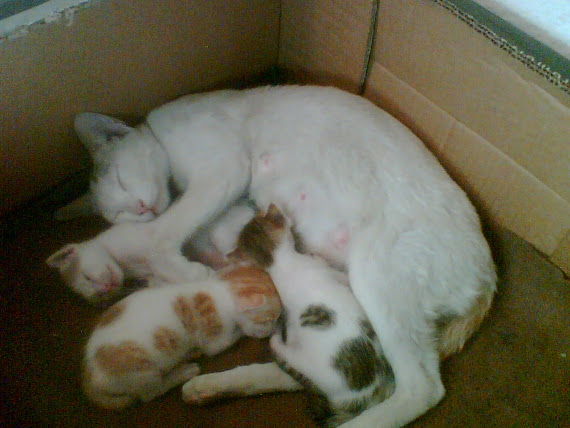
Minnu The Cat & Her Kittens Brownie, Goldie & Blackie
Someone with Nature

Syed Akbar in an island in river Godavari with Papikonda hills in the background
Recognition by World Vegetable Centre

Under the shade of Baobab tree

At Agha Khan Akademi in Kenya
Gateway to the Southern Hemisphere

Convention on Biodiversity

Syed Akbar at the 11th Conference of Parties to the United Nations Convention on Biological Diversity