Showing posts with label Agriculture. Show all posts

Wednesday, 9 January 2013

A team of researchers from Visakhapatnam has developed a bio-fertilizer that will solve the problem of zinc deficiency in green gram, increase the yield and bring in profits to farmers

By Syed Akbar
Hyderabad, Jan 4: Green gram is a major ingredient in the Indian
kitchen, but this delicious pulse crop is hit by zinc deficiency
causing heavy loss to farmers. Now a team of researchers from
Visakhapatnam has developed a bio-fertilizer that will solve the
problem of zinc deficiency in green gram, increase the yield and bring
in profits to farmers.

Field trials conducted in Anakapalle town in Visakhapatnam district
have been successful with the bio-fertilizer solving the problem of
zinc deficiency in the green gram crop. Farmers spend huge amounts on
buying chemical fertilizers to overcome the problem of zinc deficiency
in green gram. Chemical fertilizers make the soil alkaline or saline,
robbing it of its ability to sustain future crops.

Dr L Anitha, associate professor, department of microbiology and food
science and technology, Gitam University, Visakhapatnam, told this
correspondent that the bio-fertilizer was developed from blue green
algae (Spirulina platensis). Dr Anitha and research scholar P Kalpana
developed the bio-fertilizer. According to Dr Anitha, they conducted
research to estimate zinc levels in green gram (Cicer arietinum) after
application of blue green algae by foliar spray on the plants from
germination for 45 days every fortnight.

Spirulina is rich in protein and trace metals. Spirulina was dried,
powdered, and applied to crops in four different concentrations. The
zinc levels were estimated using atomic absorption spectrophotometer.
The zinc concentration 36.83 mg per kg as against 29.45 mg/kg in
fields where the bio-fertilizer was not used.

“The foliar spray enhanced the zinc levels in green gram. The higher
the concentration of blue green algae the higher the zinc
concentration in the green gram crop,” she said.

Zinc plays a key role in the yield, quality and nutritional value of
agricultural crops. But use of zinc from chemical sources damages the
soil texture, though it increases the farm out. Zinc obtained through
natural sources like blue green algae not only keeps the soil texture
in good health, but also solves the problem of deficiency in crops.

The research study by the Vizag team gain significance, as 50 per cent
of the world’s agricultural crops are deficient in zinc.

Tuesday, 1 January 2013

Carbon credits: Illiterate tribals in Andhra Pradesh sell carbon credits to developed nations

By Syed Akbar
Hyderabad: Illiterate tribals of Visakhapatnam, Vizianagaram
and Srikakulam districts have something major to celebrate on the eve
of the New Year. They have generated about 80,000 carbon credits
through afforestation on barren lands. Developed nations like Canada,
Spain and Luxemburg have now lined up to buy these carbon credits from
the tribal-farmers, paying each of them Rs 2500.

For the first time in India, tribal-farmers got money for carbon
credits directly from the World Bank. The carbon credit cheques were 
distributed in Visakhapatnam on December 26. Poor tribals from
Rayagada, Koraput, and Kalahandi districts of neighbouring Orissa are
also the beneficiaries of the World Bank’s BioCarbon Fund.

About 1500 tribals had turned barren and wastelands including hilly
tracts spread over 1600 hectares into lush green social forests by
growing teak, Pongamia, mango, cashew, neem and Casuarina trees. The
green cover has resulted in the generation of 79,811 carbon credits.
This in other words means they have nullified the ill climatic effect
of 79,811 tonnes of carbondioxide or other green house gases released
into the atmosphere through human activity.

The United Nations Framework Convention on Climate Change (UNFCCC)
mandates that developed nations should purchase carbon credits. One
carbon credit equals to permit to release one tonne of carbondioxide.
Armed with the purchase of carbon credits generated by the tribals of
Andhra Pradesh, the governments of Canada, Spain and Luxemburg have
secured the legal right to emit green house gases to the extent of
credits they had bought.

Sai Kishore Nellore, executive director, Veda Climate Change Solutions
Limited, which mobilised the tribals for the massive afforestation
programme, told this correspondent that they had entered into
partnership with the BioCarbon Fund of the World Bank and a local
industry, JK Paper Mills, Rayagada, to generate carbon credits and
trade them with the developed nations. The Centre for Integrated Rural
Development of Gitam University, Visakhapatnam extended the technical
support.

“We have created a unique institutional mechanism whereby small and
marginal farmers would be able to participate in the international
carbon markets under the UNFCCC. We have realised the carbon revenue
and will distribute them to the beneficiaries. This is for the first
time that the World Bank is giving away cheques directly to people
under Emission Reduction Purchase Agreement,” Sai Kishore said.
Canada, Spain and Luxemburg will in turn fund the World Bank for the
credits purchased.

The tribal-farmers have brought degraded lands to life, helping to
control soil and water erosion, besides producing raw material for
housing, construction, and industry. The reforestation activities have
also generating high-quality greenhouse gas emissions removals that
can be measured, monitored, and verified. A World Bank team inspected
the green cover before finalising the payments.

Incidentally, this is also the first project in Asia to release the
revenue to farmers as part of the Clean Development Mechanism of the
UNFCCC in the afforestation/reforestation large-scale sector. “The
tribal-farmers have addressed the most challenging issue of our times
namely climate change mitigation, while improving their personal
living standards,” he added.

Friday, 21 September 2012

Monsoon prediction in India goes wrong most of the times as the India Meteorological Department (IMD) uses old technology to track its movement. The accuracy level of long range forecast for seasonal rainfall in the country has been just 50 per cent in the last five years

By Syed Akbar
Hyderabad: Monsoon prediction in India goes wrong most of the
times as the India Meteorological Department (IMD) uses old technology
to track its movement. The accuracy level of long range forecast for
seasonal rainfall in the country has been just 50 per cent in the last
five years.

At present, the IMD has been depending on a suite of statistical
models to predict seasonal monsoon rainfall in the country. This leads
to error in prediction on several occasions. The IMD does not have a
suitable “coupled dynamical ocean-atmospheric model” that helps in
accurate prediction of monsoon rainfall at macro and micro levels.

However, the IMD has been near accurate on the arrival of the monsoon,
its long and short range forecasts often fell short of expectations.
The average accuracy of short-range forecast has been about 70 per
cent. Even the average accuracy of aviation forecast is 77 per cent.
Aviation forecast is important for the movement of flights including
landing and takeoffs.

The IMD has been planning for long to experiment with the USA and the
UK models of monsoon predictions to achieve near accuracy on forecasts
in the country. IMD officials claim that the error in the landfall
forecast has come down at the rate of 33 km per year in the last eight
years, while the accuracy levels in 24 hours forecast of cyclone in
the Bay of Bengal increased at the rate of 7.3 km per year during the
same period.

Even the skill of district level rainfall forecast has been limited to
75 per cent during the monsoon season. However, the prediction during
non-monsoon season is 85 per cent.

Earth Sciences Minister Vayalar Ravi admitted in Parliament earlier
this week that weather being intrinsically variable, its forecast
assessment always have a margin of error and the endeavour of IMD has
always been to reduce this margin of error through the use of improved
observations and advanced models.

The IMD leadership has been taking solace arguing that even weather
centres in advanced countries too fail to predict monsoon rainfalls.
The IMD cited this year’s monsoon prediction by global centres as an
example.

The country’s premier weather prediction body has now proposed to set
up airborne probing of cyclone facility for actual and real time
assessment of cyclones in the Bay of Bengal and the Arabian Sea.

Wednesday, 22 August 2012

Deficit rainfall and drought follow a chronological pattern repeating every 2.5 years in Telangana and Rayalaseema and once in five years in coastal Andhra

By Syed Akbar
Hyderabad: In a finding that could help predict drought, farm
scientists have noticed that deficit rainfall and drought follow a
chronological pattern repeating every 2.5 years in Telangana and
Rayalaseema and once in five years in coastal Andhra.

According to a study of rain pattern in peninsular India by the Indian
Council of Agricultural Research (ICAR), the frequency of deficit
rainfall and resultant drought is once in 2.5 years in Rayalaseema and
Telangana, three years in entire Tamil Nadu, four years in Vidarbha
and north interior Karnataka, and once in five years in coastal Andhra
Pradesh, south interior Karnataka and Madhya Maharashtra.

Peninsular India witnessed El Nino during 2002, 2004, 2006 and 2009
resulting in deficit rainfall and consequent fall in production of
food grains. The years that followed showed increased farm out put.

The ICAR has also warned that the uncertainties related to monsoons
will stay and even might increase in future due to climate change. “It
is important to evolve strategies to cope with these uncertainties.
This can be done only by fully using existing scientific knowledge on
early warning systems, crop planning in relation to progress of
monsoon and timely dissemination of weather-based agro advisories to
farmers,” says ICAR’s report on “Contingency crop planning for 100
districts in peninsular India”. The city-based Central Research
Institute for Dryland Agriculture (Crida) prepared the contingency
plan report.

According to the ICAR report, “any deviation from the normal rainfall
pattern seriously affects production of food grains, fodder
availability to livestock, supply of raw materials to agro-industries,
livelihoods of rural workforce and reduces food grain supplies to the
central pool for public distribution. It leads to increase in prices
and inflation and finally affects the share of agriculture in GDP.”

Agriculture in peninsular India is predominantly rainfed with 57 per
cent area in Andhra
Pradesh, 70 per cent in Karnataka and Kerala, 82 per cent in
Maharashtra and 43 per cent in Tamil Nadu falling under rainfed
farming. The problem is compounded in case of mid-season breaks in
monsoon between July and September. “This implies regular monsoon
failures in one part or the other in this region results in serious
consequences for small and marginal farmers and livelihoods of the
rural poor. Breaks in monsoon are responsible for deficit soil
moisture conditions during early, mid and late season.


The major crops cultivated in Andhra Pradesh during kharif season
under rainfed conditions are cotton, pigeonpea, groundnut, green gram,
maize and black gram and under irrigated conditions are rice, cotton,
sugarcane, maize, pearl millet, sunflower and groundnut.

The agricultural gain by Bt cotton farmers seems to be at the cost of other ryots. The bollworm, which used to feed on cotton before the Bt variety was introduced, has now found new hosts for survival

By Syed Akbar
Hyderabad: The agricultural gain by Bt cotton farmers seems
to be at the cost of other ryots. The bollworm, which used to feed on
cotton before the Bt variety was introduced, has now found new hosts
for survival.

Bt cotton is poisonous for the cotton bollworm and it cannot survive
on its leaves. To avoid death in Bt cotton fields, the insect, which
belongs to the butterfly family, has cleverly migrated to new plant
hosts for survival.

The bollworm is now attacking crops like tomato, pigeon pea, chickpea,
sorghum and maize. The agricultural loss, which cotton growers
suffered earlier, has shifted to farmers growing food crops. This has
led to increase in use of pesticides by non-Bt cotton farmers to
reduce the additional loss.

“Cotton bollworm has about a dozen plant hosts including the wild
varieties. The mother insect is a long flier and in the absence of
cotton, it lays eggs on new plant hosts for its larvae to feed on. It
is a smart insect and its survival tactics has led it away from
poisonous Bt cotton to non-poisonous plant varieties grown in the
vicinity,” said senior researcher MA Qayyum.

There are no reports of reduction in the population of cotton bollworm
and this indicates that it has adapted to non-bt cotton crops to lay
eggs and populate its species.

There have been no scientific studies on the additional loss to
farmers growing other crops. However, field observations show that the
shifting of bollworm from Bt cotton to food crops has resulted in
farmers losing at least 20 per cent of their yields. Thanks to the
pest migration, the bollworm has found a continuous life, from one
season to other, pointed out Qayyum, who had conducted field research
studies on Bt cotton for about a decade now.

Dr PV Satheesh, national convenor of Southern Action on Genetic
Engineering, said given the choice between cotton and red gram, the
bollworm prefers red gram. “If you control the pest using Bt
technology, it will find new sources of food for survival. We have to
access the damage caused to other crops with the shift in plant
hosts,” he added.

Red gram seems to be the most affected crop with the shift in pest’s
preference. Earlier, farmers used to grow a few layers of red gram
plantation along with cotton to detract the attention of bollworm from
cotton to red gram. Farmers stopped this practice after the
introduction of Bt cotton. Red gram once served as a “trap crop” for
cotton farmers, but now it has turned into a target crop by the
bollworm.

Friday, 20 July 2012

Monsoon 2012: Drought conditions, but no El Nino effect so far

By Syed Akbar
Hyderabad, July 19: There is no El Nino effect this monsoon and the
rains thus far have been almost normal, clarifies the Indian Council
of Agricultural Research (ICAR).

According to ICAR scientists, the monsoon this year will be normal in
the next couple of days and thus, there is no need for any contingency
plan.

Addressing reporters on the sidelines of the two-day XXI regional
committee No. II meeting of ICAR here on Thursday, ICAR
director-general Dr S Ayyappan and Central Research Institute for
Dryland Agriculture (Crida) director Dr B Venkateswara Rao said el
nino effect will not be felt even during August. There may be some of
its impact during September.

They said the el nino signal is weak and normal crop sown area will be
achieved by July 20. Already crop has been sown in about 30 lakh
hectares. The good rains in the last few days had helped farmers.
There is no cause of concern, though sowings in maize and pulses are
lagging behind the normal.

Top farm scientists from across the country are meeting in Hyderabad
to come out with an action for the agriculturally rich State of Andhra
Pradesh, besides West Bengal, Odisha and Andaman and Nicobar islands.
Governor ESL Narasimhan inaugurated the programme.

Dr Ayyappan said Malaysia had agreed to offer the germplasm of oil
palm to India. This will boost edible oil production in the country
from three tons a hectare to 10 tonnes a hectare.

Project Ananta: Mega plan to stop desertification of Anantapur district in Andhra Pradesh, India

By Syed Akbar
Hyderabad, July 19: The Indian Council of Agricultural Research (ICAR)
has come out with a mega plan to prevent desertification of Anantapur
district and increase farm output through innovative technological
interventions including satellite imagery to revive the lost rivers.


Called Project Ananta, the ICAR’s Rs 500 crore plan also aims at
gradual weaning away of groundnut farmers to guar gum cultivation,
setting up sheep and fodder research stations and posting an IAS
official to exclusively deal with farm and allied activities.

Over a dozen ICAR scientists including its director-general Dr S
Ayyappan visited 30 villages in Anantapur and interacted with over
2000 farmers before preparing the Project Ananta. He said the report
was submitted to the State government. Governor ESL Narasimhan, who
participated in an ICAR meeting to chalk out action plan for Andhra
Pradesh and other States, asked officials to speedily translate the
project into reality.

Using satellite imagery data, scientists will find out the original
course of rivers, streams and other water bodies in Anantapur. Once
their course is identified, obstacles will be removed to ensure that
rain water flows into them. This will help not only in reviving the
dead water bodies, but also in the recharge of the ground water, said
Dr B Venkateswara Rao, director of the Central Research Institute for
Dryland Agriculture (Crida). One good rainfall will fill up the tanks.

As part of the Project, 15 of the 50 mandals in the district that have
been constantly witnessing failure of groundnut crop will be selected
for cultivation of guar gum. To begin with, about 1000 acres in
Tadipatri area will guar gum from Rajasthan. “There is acute shortage
of guar gum seeds. We are initially taking up its cultivation in a few
pockets,” he added.

Saturday, 19 May 2012

Scientists decode impact of El Nino on crop production

Syed Akbar
Hyderabad:  City scientists have decoded the impact of El
Nino phenomenon on the overall farm productivity in Andhra Pradesh. El
Nino is a pervasive climatic event that triggers changes in climate at
regional level primarily affecting agricultural production.

In a first of its kind study on the El Nino effect on Indian
agriculture, a team of researchers from the city-based Central
Research Institute for Dryland Agriculture (Crida) has found that El
Nino is more pronounced in Rayalaseema compared to
Telangana followed by coastal Andhra. Districts like Anantapur and
Kurnool experience negative departure in average southwest monsoon
rainfall by more than 20 per cent.

The team comprised VUM Rao, AVM Subba Rao, B Bapuji Rao, BV Ramana
Rao, C Sravani and B Venkateswarlu. According to Crida scientists, the
performance of southwest monsoon in the country has a tele link with
El Nino phenomenon. They analysed long-term data and found an inverse
relationship between El Nino and southwest monsoon rainfall in India.
The research study included the impact on the productivity of crops
like rice, groundnut, castor, pigeonpea, chickpea and pearl millet.

The average southwest monsoon rainfall received during the years with El Nino
was found to be less compared to normal years and the average rainfall
during the northeast monsoon is higher in coastal Andhra. Either the
southwest monsoon rainfall or the annual rainfall will be less during
the years with El Nino.

Barring SPS Nellore district, the average total food grain production
throughout
the State declined during El Nino years. The decrease in production
was more than 10 per cent in several districts. Anantapur recorded 10
per cent fall in groundnut production. During kharif season, there was
a decline in average production of rice by 12 per cent in the State.
When the total food grain production excluding rice was examined, the
decline in production and productivity appeared to be more than 25 per
cent.

The Crida study suggested inter-cropping systems with long duration
base crop and short duration inter-crop in traditional rain-fed
mono-cropping areas, and increase in productivity of rabi crops by
judicious use of fertilizers and adoption of pest and disease control
during the early stages of its growth. It also recommended system of
rice intensification (SRI) during Khariff in case of El Nino, and
moisture conservation practices for mango, cashew and coconut to
increase their yields.

Saturday, 26 November 2011

Sorghum (jowar) is now a smart crop, to fight climate change

Syed Akbar
Hyderabad, Nov 22: The humble jowar (sorghum), long considered as a
poor man’s food, has now emerged as a “smart” agricultural crop that
could fight against global warming and climate change.

The city-based Directorate of Sorghum Research (DSR) on Tuesday
claimed that jowar varieties are capable of mitigating the impact of
global warming by regulating the emission of greenhouse gases in the
environment. The DSR scientists also claimed that some varieties of
sorghum are completely fit into the new system of climate smart
agriculture.

According to Dr JV Patil, director of DSR, sorghum is a special type
of plant classified under C4 group of plants. Though C4 plants occupy
just one per cent of all known plant species, they fix as much as 30
per cent of the earth’s carbon. Sorghum takes back all the
carbondioxide and methane gases and thus can be described as “zero
emission” plant varieties.

Jowar also plays a vital role in regulating nitrous oxide. The brown
mid-rib varieties of jowar have lower lignin and higher digestibility,
Dr Patil said adding that even cattle that feed on jowar fodder do not
release methane gas into the atmosphere.

“Sorghum is one of the cheapest sources of micronutrients like iron
and zinc and with roughage and slow release of carbohydrates it is
preferred food for diabetics and obese population,” he added.

World Agricultural Forum: Icrisat fighting against poverty, hunger

Syed Akbar
Hyderabad, Nov 25: The International Crops Research Institute for the
Semi-Arid Tropics (Icrisat) will lead representatives from world
agriculture organisations in a discussion on South-South collaboration
to fight poverty in the dryland tropics.

At the World Agricultural Forum 2011 congress being held in Brussels,
a session on “The Role of South-South Partnerships” will address
opportunities to boost collaboration between India and Africa. It will
focus on finding new ways to feed the growing global population, and
in improving the livelihoods of marginalised, resource-poor
smallholder farmers particularly in the drylands of Asia and
sub-Saharan Africa.

“We believe that South-South partnership is the key to solving hunger
and poverty and in stimulating a greener, more productive drylands,”
says Dr William Dar, director-general of Icrisat and moderator of the
WAF session on South-South partnerships in the afternoon of November 30.

Dr Nigel Poole, chairman of the ICRISAT Governing Board, said “India
shares similar poverty and infrastructure issues with Africa, so when
successful solutions are found they need to be transferred if we
really want to implement change. Reaching out to the rural poor of
India and Africa with our research and technologies is a key challenge.”

Friday, 9 September 2011

Crop holiday: Farm scientists fear that crop holiday in AP may turn contagious

By Syed Akbar
Hyderabad, Aug 23: The Indian Council of Agricultural Research fears
that the crop holiday declared by farmers in some villages of East
Godavari district will turn contagious and spread to all parts of the
country.

"The situation is serious and we are addressing the issue. It may
spread to other areas in the country," said ICAR deputy
director-general Dr AK Singh. Taking a cue from their counterparts in
East Godavari, farmers in parts of Kurnool, Khammam and Nellore
districts have already announced their intention to go in for a crop
holiday this khariff, and extend it to rabi too.

The ICAR has sent an expert team to East Godavari for a first hand
assessment of the problem. The team found that farmers have been
suffering losses because of poor returns and imbalance between input
cost and the revenue they earn from the yield. The Mohan Kanda panel
on crop holiday also deputed its team to the district. The ICAR team
has already submitted its report to the Centre, while the Mohan Kanda
committee is busy preparing its report.

"What is worrying is that farmers want to continue the crop holiday
during rabi season too. This is really a trouble situation. Rabi is
the season when farmers except some good returns. They want extend the
crop holiday from khariff to rabi season too. The argument of farmers
is that the more they sow the more the loss; the lesser they sow the
lesser the loss; and no sowings and no loss," Dr MV Rao, former
special director-general ICAR said. Dr Rao is member of the Mohan
Kanda panel.

Dr B Venkateswarlu, director of Central Research Institute for Dryland
Agriculture, said farmers do not need any technological intervention,
but a change in government policies. "We have submitted our report to
the government. The Centre and the State will definitely do something
to help farmers," he said adding that the situation is quite "serious".

Dr Singh pointed out that there's no surplus production of food grains
in the country and if stocks have piled up with farmers, it's because
of lack of purchasing power by poorer sections. "The production target
is as per the population of the country. The poor do not have money to
purchase enough grains and this leads to piling up of grains with
farmers," he clarified.

The senior agricultural scientists deliberated the agricultural
scenario in the  country and the impact of climate change on crops, at
a national conference on sustainable agriculture and climate change
here on Tuesday. They said India has been identified as one of the
countries that will have greater challenges from global warming which
will have an impact on food security.

Wednesday, 24 August 2011

Crop holiday takes ICAR by surprise; fears that crop holiday in AP may spread to other States

Syed Akbar
Hyderabad, Aug 23: The Indian Council of Agricultural Research fears that
the crop holiday declared by farmers in some villages of East Godavari
district will turn contagious and spread to all parts of the country.

"The situation is serious and we are addressing the issue. It may spread to
other areas in the country," said ICAR deputy director-general Dr AK Singh.
Taking a cue from their counterparts in East Godavari, farmers in parts of
Kurnool, Khammam and Nellore districts have already announced their
intention to go in for a crop holiday this khariff, and extend it to rabi too.

The ICAR has sent an expert team to East Godavari for a first hand
assessment of the problem. The team found that farmers have been suffering
losses because of poor returns and imbalance between input cost and the
revenue they earn from the yield. The Mohan Kanda panel on crop holiday
also deputed its team to the district. The ICAR team has already submitted its
report to the Centre, while the Mohan Kanda committee is busy preparing its
report.

"What is worrying is that farmers want to continue the crop holiday during
rabi season too. This is really a trouble situation. Rabi is the season when
farmers except some good returns. They want extend the crop holiday from
khariff to rabi season too. The argument of farmers is that the more they sow
the more the loss; the lesser they sow the lesser the loss; and no sowings and
no loss," Dr MV Rao, former special director-general ICAR said. Dr Rao is
member of the Mohan Kanda panel.

Dr B Venkateswarlu, director of Central Research Institute for Dryland
Agriculture, said farmers do not need any technological intervention, but a
change in government policies. "We have submitted our report to the
government. The Centre and the State will definitely do something to help
farmers," he said adding that the situation is quite "serious".

Dr Singh pointed out that there's no surplus production of food grains in the
country and if stocks have piled up with farmers, it's because of lack of
purchasing power by poorer sections. "The production target is as per the
population of the country. The poor do not have money to purchase enough
grains and this leads to piling up of grains with farmers," he clarified.

The senior agricultural scientists deliberated the agricultural scenario in the
country and the impact of climate change on crops, at a national conference
on sustainable agriculture and climate change here on Tuesday. They said
India has been identified as one of the countries that will have greater
challenges from global warming which will have an impact on food security.

Saturday, 22 August 2009

Failing crops in Andhra Pradesh: 10 per cent of land turns saline or alkaline


By Syed Akbar
Hyderabad: As much as 10 per cent of rich agricultural land in the State has turned either saline or alkaline posing a serious threat to the over all farm production.
Farm experts attribute the drastic change in the delicate soil texture in several districts in the State to indiscriminate use of chemical fertilisers and pesticides over a period. The extent of salinity or alkalinity is so severe in some agricultural fields that not even grass grows on them. These soils are practically dead and unproductive.
Moreover, recent sociological changes have compounded the soil problems as traditional practices like application of green manuring have slowly started disappearing. "These changes are in the nature of leasing of land, which has been on the rise. In this case, neither the lease holder nor the land owner is interested in long term soil health management nor have time to plant, raise and incorporate green manure crop," says an official in the farm department.
The difference between normal fields and those affected by salinity or alkalinity is clearly visible even to the naked eye in delta areas. The worst affected districts include Krishna, Guntur, East and West Godavari, Prakasam, Nellore, Nizamabad, Warangal and Kurnool.
Also intensive agriculture, specially in irrigated lands, and heavy application of inorganic fertilisers has led to increase in extent of problematic soils. While 10 per cent of land is either saline or alkaline, nearly 20 per cent of the total cropped area is water logged. Water logging gradually destroys soil health.
Continuous water logging due to ground water besides rainfall recharge in these areas have turned thousands of hectares of land into alkaline. The soils become alkaline due to accumulation of chemical compounds like carbonates and bicarbonates.
It is estimated that about 7.55 lakh hectares of area is problematic soils in the State, which calls for an immediate reclamation on a massive scale to restore the productivity of these lands. Waking up to the problem, though late, the government has succeeded in reclaiming about 10,000 hectares in five districts. The State has 104.12 lakh hectares under agriculture.

Bt cotton seeds are a failure

By Syed Akbar
Hyderabad: It is now official. Bt cotton seeds are a failure, at least in Andhra Pradesh.
The Genetic Engineering Approval Committee of the Union Ministry of Environment and Forest has accepted the contention of farmers and farm organisations that Bt cotton seeds supplied by Mahyco-Monsanto India Limited have failed to deliver the promised results.
The damning report comes just ahead of a review of the permission granted by the Centre for the cultivation of Bt cotton. The permission, given in 2002, was to be reviewed on Friday.
“The fact of yield losses varying from 30 to 60 per cent on an average and even 80 per cent in a few cases, is clearly borne out from the verification reports submitted by the joint teams constituted for the purpose. It is also evident that, whatever may be the other contributing factors, the Bt cotton varieties in question have failed to perform up to the standards that were promised and expected. The poor performance is reflected not only in their vulnerability to diseases, but also in the square/flower dropping that was observed in several fields,” the GEAC report pointed out.
Meanwhile, a report of the MoU committee (Joint Director, Agriculture) has also found fault with the seed company. It even suggests that “M/s Mahyco Monsanto Ltd, is liable for payment of damages at the rate of Rs 1,496.25 per acre and a total amount of Rs 2,48,85,630 in respect of the affected extents... The company shall take necessary action for payment of the compensation accordingly within the period prescribed under MoU, namely 30 days, failing which this award will carry interest at the rate of 24 per cent per annum.”
Thousands of farmers in Warangal, Guntur and Mahbubnagar districts have lost heavily after they changed to Bt version of cotton from conventional hybrid varieties three years ago. While farmers, farm organisations and NGOs blame crop failures on the genetically modified seeds, economists and farm experts prefer to tread a cautious path.
The GEAC and MoU Committee reports only confirm research conducted by NGOs and the NG Ranga Agricultural University which found that there was no substantial difference in use of pesticides with Bt cotton, and the yields were the same if not less. What is more, Bt cotton was vulnerable to attack by other pests like aphids.
Farmers reported that there was an increase of 300 per cent in non-target pests like jassids, aphids and thrips. Bt cotton crop has been attacked by wilt and root rot. Many complain that higher yields of up to 15 quintals per acre were promised, whereas the average yields of Bt Cotton were two to three quintals per acre. Nowhere did Bt Cotton yields cross more than four quintals per acre at the end of the harvest.

GENETRICKS
Bt Cotton is a genetically engineered form of natural cotton. It contains the property of insect-specific resistance through the transfer of a gene from Bacillus thuringiensis (Bt for short). The Bt variety produces a protein which when ingested in adequate quantities is toxic to lepidopteron insects. The Bt cotton is specifically targeted at the most serious scourge of the cotton crop, the boll worm.
In AP, Mayhco-Monsanto and the home-grown Raasi sell Bt cotton seeds. Monsanto provides the Bt genes and the seeds are developed by Mayhco.
Genetically modified cotton varieties were introduced in the State during 2001-2002 amidst stiff resistance by environmentalists and social activists. The government had earlier banned field trials of Bt cotton.
Farmers grow Bt cotton in over 80,000 hectare in the State. Bt cotton seed varieties are sold at Rs 1,600 per packet of 450 gram, against Rs 400 per packet of non-Bt varieties. A Bt-cotton farmer spends around Rs 16,000 per hectare against Rs 10,000 by conventional cotton growers. The returns, however, are almost the same.
Bt cotton was sold by Monsanto with the promise that, by genetically altering the seed it could develop resistance to boll worm, the commonest and most serious scourge of cotton.
Monsanto does not sell its seeds directly, it markets the varieties through its Indian agent Mahyco. Monsanto’s Bt genes are utilised by Mahyco to produce Bt cotton seeds. The high protein content in the Bt varieties make them consume more water upsetting the delicate ecological balance.

COMPENSATION
Andhra Pradesh, one of the most proactive States in safeguarding the rights of cotton farmers, responded to the increase in farmers’ suicides by introducing a MOU, with the primary aim to arbitrate cases involving seed companies and farmers and to provide quick relief to the latter. Repeated failure of Bt Cotton in the State in 2002-03 and 2003-04 caused the government to make Monsanto-Mahyco accountable to the farmers in Bt. Cotton.
The chairmen of MoU District Level Committee have no hesitation in holding that the defects noticed in Bt. Cotton varieties in question, should be attributed to the genetic impurity and inadequacy of the parent seed used by the company for genetic modification.

DIFFERING VIEWS
According to economist and Chronicle columnist Jayati Ghosh, chairperson of the State Farmers Welfare Commission, an integrated pest management system is the best solution. “During my visits to Guntur, Mahbubnagar and Warangal districts, many farmers brought to my notice that Bt cotton seed was resistant to one particular type of pest. Pesticide usage has not come down. Some farmers said the crop was bad other reported it was not better,” she said.
She feels that farmers have gone in for Bt cotton without adequate knowledge of the varieties they are using. Farmers should look at alternative varieties and opt for alternative pest management methods.
Genetically modified varieties including cotton find a supporter in internationally renowned biologist Dr M S Swaminathan. “We have a lot of things to look into. Before coming to a conclusion, we should look into other factors as well. There are a number of reasons for crop failure. You cannot specify one particular reason,” he said.
State agriculture officials do not find fault with Bt technology per se. "Bt technology is OK. The fault lies with the so-called Bt seed varieties. Certain varieties of Mahyco have failed in the State while those of Rasi are performing wonderfully well", clarifies T Peddi Reddy, additional director of agriculture.
On the production side, Bt varieties are as good as any hybrid variety. The only advantage of Bt cotton is that it is resistant to boll worm and consumes less quantity of pesticide. He said the State government had sent samples of Mahyco seeds to the Cotton Research Centre in Nagpur to verify if they contained the Bt gene.
Environmentalists argue that field trials on Bt cotton varieties were not conducted properly and nor were the results evaluated scientifically. While many countries have fixed a mandatory field trial for six years before granting approval for commercial production, the Central government gave its approval after four years of field trials.
Says State Farmers’ Welfare Commission member Y V Malla Reddy, “the cost of cultivation of Bt cotton is higher but the yields are not commensurate with the expenditure. Bt cotton has both advantages and disadvantages. What many overlook are the unintended benefits. Traders and seed companies deliberately hide the negative side of the products they market.”
He points out that Bt cotton trials were not open for independent scrutiny. Trials were done on very small plots of land and the data sought to be extrapolated into real situations and growing conditions.

DAMNING REPORTS
Genetic Engineering Approval Committee, Government of India: Report largely agrees that Bt cotton seeds provided by Monsanto-Mahyco India Ltd caused heavy losses to farmers. “The fact of yield losses varying from 30 to 60 per cent on an average and even 80 per cent in a few cases, is clearly borne out from the verification reports submitted by the joint teams constituted for the purpose. It is also evident that, whatever may be the other contributing factors, the Bt cotton varieties in question have failed to perform up to the standards that were promised and expected. The poor performance is reflected not only in their vulnerability to diseases, but also in the square/flower dropping that was observed in several fields,” the report said.
The report of the Joint Director Agriculture says, “some members of the MoU committee (a panel set up to decide on compensation for farmers who lost their Bt cotton crop) have expressed a doubt whether the seed defect as now noticed in the Bt varieties and the consequent losses suffered by the farmers can be brought under the contingency of genetic impurity.”
Mahbubnagar Regional Agricultural Research Station, Acharya NG Ranga Agriculture University: The station collected data on Bt cotton performance from 100 farmers from Mahbubnagar, Nalgonda, Rangareddy and Medak districts. It noted that the expenditure on Bt Cotton did not decrease but rather increased. The net income from Bt cotton was almost negligible compared to other hybrids. In Ranga Reddy district, farmers have negative incomes from Bt cotton.
The station reported that the average pesticide use with Bt cotton was one spray lesser than non-Bt hybrids. While 61 per cent of the farmers surveyed found that Bt cotton was effective against boll worm up to three months, 39 per cent found no difference between Bt and non-Bt cotton varieties. Only in Medak district did Bt cotton generate more income to farmers than non-Bt hybrids.
The university team found that Bt cotton was unable to withstand water or moisture stress unlike conventional varieties.
Centre for Sustainable Agriculture, Secunderabad: Report said Bt cotton has not been yielding the desired results. According to the CSA study, the incidence of pests, especially bollworm, was still high despite the huge production cost of Rs 2,632 per acre. Cotton production had witnessed better results when organic methods of cultivation had been used, with the expenditure at Rs 382 per acre. The centre has strongly recommended against continuing the cultivation of BT cotton, and has called for more non-pesticidal cultivation of cotton.
Gene Campaign, Delhi: The agricultural policy think tank in its Bt cotton evaluation study reported complete failure of the crop. It reported 60 per cent of the farmers did not recover costs and that most of them incurred a loss of Rs 80 an acre. The seed cost per acre is four times that of quality non-Bt varieties. The savings on pesticides is a mere Rs 217 an acre, while the seed cost, including the licence fee for using the patented Bt seeds, is Rs 1,200 higher.

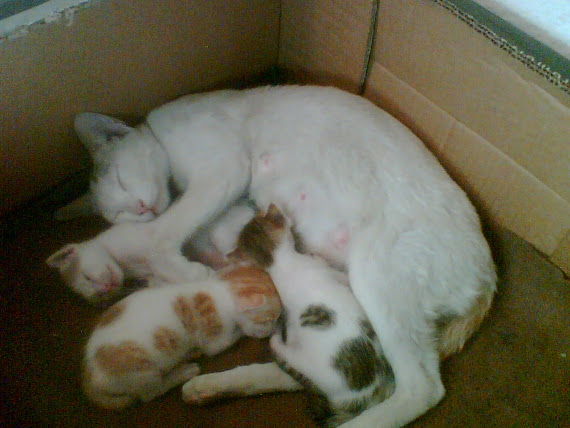
Mother's Care

Mother's Care
Minnu The Cat & Her Kittens Brownie, Goldie & Blackie

Someone with Nature

Someone with Nature
Syed Akbar in an island in river Godavari with Papikonda hills in the background

Recognition by World Vegetable Centre

Recognition by World Vegetable Centre

Under the shade of Baobab tree

Under the shade of Baobab tree
At Agha Khan Akademi in Kenya

Gateway to the Southern Hemisphere

Gateway to the Southern Hemisphere

Convention on Biodiversity

Convention on Biodiversity
Syed Akbar at the 11th Conference of Parties to the United Nations Convention on Biological Diversity