Syed Akbar
Hyderabad, April 11: A major earthquake measuring 8.5 on the Richter scale off the west
coast of northern Sumatra in Indonesia on Wednesday afternoon triggered tremors in
several parts of South India sending people into panic.
The city-based Tsunami Early Warning Centre (TEWC), which issued a tsunami alert for
coastal areas in Tamil Nadu, Kerala, Karnataka and Andhra Pradesh besides Andaman and
Nicobar islands, later withdrew it as the seismic waves could not trigger a large
tsunamigenic event in the Indian Ocean. Wednesday’s earthquake is the seventh biggest
earthquake in the last 100 years and it triggered a series of aftershocks. The TEWC
recorded as many as seven earthquakes of magnitudes less than 7 after the major one
measuring 8.5.
The tsunami threat receded as the earthquake generated seismic waves horizontally and
this explains why tremors were felt thousands of kilometres away from the epicentre in
Sumatra. Had the waves traveled vertically there would have been a possibility of a major
tsunami generating in the Indian Ocean.
Thousands of people came out of homes, offices, schools and shopping complexes as mild
tremors were felt in Vijayawada, Nellore, Ongole, Visakhapatnam, Srikakulam, Kakinada and
Machilipatnam. Reports of tremors also came in from Chennai and other parts of Tamil
Nadu, Kolkata, Bengaluru, Bhubaneswar and Thiruvanantapuram, and parts of Assam. Andhra
Pradesh and Tamil Nadu bore the brunt of the tsunami on December 26, 2004.
“The tremors were due to the earthquake in Sumatra and there was no threat of an
earthquake in Andhra Pradesh. It was a major earthquake and thus the tremors were felt in
far away places,” said Dr RK Chada, senior scientist at the city-based National
Geophysical Research Institute.
Keeping in view the huge loss to human life and property in the December 26, 2004 tsunami
in Andhra Pradesh, Tamil Nadu and Andamans and Nicobar islands, the National Disaster
Management Authority (NMDA) alerted State governments, the Coast Guard and the Army.
Tsunami sirens were sounded in coastal villages and district authorities swung into
action warning people living on the shore.
The tremors in Andhra Pradesh and Tamil Nadu came handy for anti-nuclear power plant
activists, who questioned the safety of the existing plants in Tamil Nadu and the
proposed mega nuclear park at Kovvada in Srikakulam district. Meanwhile, officials at the
Kudankulam Nuclear Power Plant, which is all set to go critical in the next few months,
said work at the site was not affected.
"We received the alert from Indian National Centre for Ocean Information Services
(Incois) and we are generally on alert. But our work is continuing," said M Kasinath
Balaji, Kudankulam plant site director. The Nuclear Power Corporation of India Limited,
which has revisited its units after the Fukushima event in Japan last year, built 7.5
metres high walls around the Kudankulam plant. The nuclear plant was constructed at a
raised platform to avoid inundation in case of a major tsunami.
According to reports from Indonesia, the first 8.5 magnitude earthquake near Sumatra had
spawned a wave around 30 inches high but caused no serious damage. The second, an 8.2
magnitude aftershock also struck off the coast of Indonesia's Sumatra island. Operations
at Chennai port were suspended because of the tsunami alert.
The projections issued by the Indian Tsunami Early Warning Centre (ITEWC) showed the
tidal waves triggered by the quake hitting parts of Nicobar, Komatra and Katchal minutes
after it struck the region at 14:08 IST. The ITEWC also issued an alert for coastal
Tamil Nadu, Andhra Pradesh and the Andaman islands forecasting the arrival time of the
first wave.
The Andhra Pradesh government put officials of nine coastal districts on high alert.
Instructions were given to them to take all precautionary measures and utilise the
services of armed forces, if required, to meet any eventuality. Collectors were asked to
open control rooms and ask fishermen, who ventured into the sea, to return home
immediately and also evacuate people from the beaches.
NDMA vice-president M Sashidar Reddy said no waves were noticed in Andaman and Nicobar
Islands and the possibility of a tsunami was virtually ruled out.
Showing posts with label Nature. Show all posts
Showing posts with label Nature. Show all posts
Wednesday, 11 April 2012


How social networking and microblogging sites help in Tsunami
Syed Akbar
Hyderabad, April 11: When a major tsunami last hit the Indian Ocean on December 26, 2004
newspapers and TV channels were taking pains to explain what tsunami is.
Seven years later, tsunami is a popular term and Wednesday's earthquake off the west
coast of northern Sumatra triggered a wave of trends on social networking and
microblogging sites. Facebook witnessed thousands of postings alerting friends and near
and dear ones while on twitter seven of the top 10 trends were related to tsunami.
Even national governments utilized Twitter and Facebook to issue alerts about tsunami.
The Union Ministry of External Affairs kept on posting updates about the event and
alerted Indians living in tsunami prone countries particularly Indonesia, Thailand,
Malaysia and Singapore. External Affairs Ministry official spokesperson Syed Akbaruddin
tweeted that control rooms are being set in Indian Mission in Jakarta and Consulate in
Medan to assist Indian nationals if required.
Thanks to mobile phone smses, social networking and microblogging sites, people started
taking precautionary measures even before the governments officially issued early tsunami
warning alerts to citizens. Thousands of smses were exchanged within the first 10 minutes
of the 8.5 magnitude earthquake that shook among others several parts in south India
including Chennai, Puducherry, Nellore, Ongole, Vijayawada, Kakinada and Visakhapatnam.
On Twitter, “earthquake”, “tsunami”, “Indian Ocean”, “Sumatra”, “Aceh”, “Richter” and
“Magnitude 8.9” trended right from the afternoon. The trends not only alerted people
about a possible tsunamigenic event, but also about the safety measures one should take.
Ironically, most of the local TV channels created more panic than reassuring and
educating people.
Israeli model Bar Refaeli tweeted, “My god. Hearing about the earthquake in Indonesia. My
thoughts are there. Tsunami warnings. Crossing fingers that nothing will happen”.
The BBC reassured people that there was “less likely" of a tsunami because earthquake off
Indonesia moved horizontally and not vertically.
When a seismic waves travel horizontally, they travel within the earth and this explains
why tremors were felt as far away as Andhra Pradesh. But when the waves travel
vertically, i.e. towards the sea surface the water in the ocean moves up triggering a
massive movement of tsunami waves.
Hyderabad, April 11: When a major tsunami last hit the Indian Ocean on December 26, 2004
newspapers and TV channels were taking pains to explain what tsunami is.
Seven years later, tsunami is a popular term and Wednesday's earthquake off the west
coast of northern Sumatra triggered a wave of trends on social networking and
microblogging sites. Facebook witnessed thousands of postings alerting friends and near
and dear ones while on twitter seven of the top 10 trends were related to tsunami.
Even national governments utilized Twitter and Facebook to issue alerts about tsunami.
The Union Ministry of External Affairs kept on posting updates about the event and
alerted Indians living in tsunami prone countries particularly Indonesia, Thailand,
Malaysia and Singapore. External Affairs Ministry official spokesperson Syed Akbaruddin
tweeted that control rooms are being set in Indian Mission in Jakarta and Consulate in
Medan to assist Indian nationals if required.
Thanks to mobile phone smses, social networking and microblogging sites, people started
taking precautionary measures even before the governments officially issued early tsunami
warning alerts to citizens. Thousands of smses were exchanged within the first 10 minutes
of the 8.5 magnitude earthquake that shook among others several parts in south India
including Chennai, Puducherry, Nellore, Ongole, Vijayawada, Kakinada and Visakhapatnam.
On Twitter, “earthquake”, “tsunami”, “Indian Ocean”, “Sumatra”, “Aceh”, “Richter” and
“Magnitude 8.9” trended right from the afternoon. The trends not only alerted people
about a possible tsunamigenic event, but also about the safety measures one should take.
Ironically, most of the local TV channels created more panic than reassuring and
educating people.
Israeli model Bar Refaeli tweeted, “My god. Hearing about the earthquake in Indonesia. My
thoughts are there. Tsunami warnings. Crossing fingers that nothing will happen”.
The BBC reassured people that there was “less likely" of a tsunami because earthquake off
Indonesia moved horizontally and not vertically.
When a seismic waves travel horizontally, they travel within the earth and this explains
why tremors were felt as far away as Andhra Pradesh. But when the waves travel
vertically, i.e. towards the sea surface the water in the ocean moves up triggering a
massive movement of tsunami waves.
India proves its scientific prowess as a regional tsunami service provider in the Indian Ocean
Syed Akbar
Hyderabad, April 11: India on Wednesday proved its scientific prowess as a regional
tsunami service provider (RTSP) exchanging a number of bulletins with over two dozen
countries in the Indian Ocean on the tsunami wave movement in real time. And Hyderabad,
where RTSP India is located, played the key role in keeping several national tsunami
early warning centres posted of the amplitude of the tsunami waves as they traveled from
the epicenter. The warning was withdrawn as the wave movement was not expected to trigger
a tsunamigenic event.
India became an RTSP nation on October 12, 2011 and Wednesday’s 8.5 magnitude earthquake
in the Indonesian island of Sumatra was the first major earthquake after the country
joined the elite club of RTSP nations. There have been several small earthquakes since
October 12 last year, but Wednesday’s earthquake rated as “great” by seismologists was
the real first hand experience for tsunami scientists in India. The earthquake generated
tsunami waves.
The tsunami team at the city-based Tsunami Early Warning Centre (TEWC) issued six public
bulletins within three hours recording six earthquakes, three each in the north Indian
Ocean and off the west coast of northern Sumatra. Only one of them was of 8.5 magnitude,
the rest being 7 or lower than 7 on the Richter scale.
“The RTSP India monitored sea level gauges near the epicentre and reported tsunami wave
activity. It was the first major earthquake after the Indian Ocean tsunami mock drill on
October 12, 2012. We shared real time data with other RTSPs and countries in the Indian
Ocean rim,” said Dr T Srinivas Kumar, head of the TEWC.
The TEWC located at the Indian National Centre for Ocean Information Services (INCOIS) at
Pragathinagar here provided seismic and tsunamigenic information with Australia,
Bangladesh, Comoros, France (La Réunion), India, Indonesia, Iran, Kenya, Madagascar,
Malaysia, Maldives, Mauritius, Mozambique, Myanmar, Oman, Pakistan, Seychelles,
Singapore, Sri Lanka, Tanzania, Thailand, Timor Leste, and Yemen. It was 08:38:35 UTC
when the earthquake was recorded at a depth of 10 km off the west coast of northern
Sumatra and within no time the information was passed on to the Indian Ocean rim
countries.
The evaluation message from Hyderabad read: “Sea level observations have confirmed that a
TSUNAMI WAS GENERATED”. Following the message the Indian Ocean rim countries put their
official machinery on high alert and tsunami sirens were sounded in a few countries
including Indonesia. The real time wave movement was also provided to the member nations.
Senior earthquake scientist Dr RK Chadha said since the earthquake in Sumatra was of a
large magnitude, tremors were felt in several parts of south India including Chennai,
Vijayawada, Nellore, Kakinada, Visakhapatnam, Ongole and Machilipatnam.
Hyderabad, April 11: India on Wednesday proved its scientific prowess as a regional
tsunami service provider (RTSP) exchanging a number of bulletins with over two dozen
countries in the Indian Ocean on the tsunami wave movement in real time. And Hyderabad,
where RTSP India is located, played the key role in keeping several national tsunami
early warning centres posted of the amplitude of the tsunami waves as they traveled from
the epicenter. The warning was withdrawn as the wave movement was not expected to trigger
a tsunamigenic event.
India became an RTSP nation on October 12, 2011 and Wednesday’s 8.5 magnitude earthquake
in the Indonesian island of Sumatra was the first major earthquake after the country
joined the elite club of RTSP nations. There have been several small earthquakes since
October 12 last year, but Wednesday’s earthquake rated as “great” by seismologists was
the real first hand experience for tsunami scientists in India. The earthquake generated
tsunami waves.
The tsunami team at the city-based Tsunami Early Warning Centre (TEWC) issued six public
bulletins within three hours recording six earthquakes, three each in the north Indian
Ocean and off the west coast of northern Sumatra. Only one of them was of 8.5 magnitude,
the rest being 7 or lower than 7 on the Richter scale.
“The RTSP India monitored sea level gauges near the epicentre and reported tsunami wave
activity. It was the first major earthquake after the Indian Ocean tsunami mock drill on
October 12, 2012. We shared real time data with other RTSPs and countries in the Indian
Ocean rim,” said Dr T Srinivas Kumar, head of the TEWC.
The TEWC located at the Indian National Centre for Ocean Information Services (INCOIS) at
Pragathinagar here provided seismic and tsunamigenic information with Australia,
Bangladesh, Comoros, France (La Réunion), India, Indonesia, Iran, Kenya, Madagascar,
Malaysia, Maldives, Mauritius, Mozambique, Myanmar, Oman, Pakistan, Seychelles,
Singapore, Sri Lanka, Tanzania, Thailand, Timor Leste, and Yemen. It was 08:38:35 UTC
when the earthquake was recorded at a depth of 10 km off the west coast of northern
Sumatra and within no time the information was passed on to the Indian Ocean rim
countries.
The evaluation message from Hyderabad read: “Sea level observations have confirmed that a
TSUNAMI WAS GENERATED”. Following the message the Indian Ocean rim countries put their
official machinery on high alert and tsunami sirens were sounded in a few countries
including Indonesia. The real time wave movement was also provided to the member nations.
Senior earthquake scientist Dr RK Chadha said since the earthquake in Sumatra was of a
large magnitude, tremors were felt in several parts of south India including Chennai,
Vijayawada, Nellore, Kakinada, Visakhapatnam, Ongole and Machilipatnam.
Tuesday, 5 April 2011
Tsunami in Japan impacts pearl industry in Hyderabad
2011
Syed Akbar
Hyderabad: The tsunami and subsequent radiation threat in Japan has an unique impact on Hyderabad. This ciity of pearls is hit hard with the killer tsunami badly damaging oyster culture farms and the subsequent high doses of radiation killing the molluscs that had survived the natural disaster on March 11.
According to local traders, the city pearl industry is feeling the impact of the tsunami damage to oyster farms in Japan. City pearl dealers are in constant touch with their counterparts in Japan for update on the tsunami loss.
"We will know the quantum of impact on the pearl industry in Hyderabad only after a week," said Satish Agarwal, a pearl trader. He said he "cannot assess the impact right now".
Hyderabad imports about 22 to 25 tonnes of pearls from various parts of the world including the Arabian Gulf, Indonesia, Japan and China. The share of Japanese natural pearls in the city's market is around 17 per cent. Incidentally, Japanese pearls have been sold in Hyderabad for almost 80 years.
Though China of late, sends the largest quantity of pearls to Hyderabad, the Chinese pearls, mostly fresh water cultured, do not command higher prices. Japanese pearls rank next only to those harvested in the Arabian Gulf, particularly the Basra region. The pearl business in the city is about Rs 500 crore worth, with the Japanese pearls contributing a share of Rs 90 crore a year.
"Hyderabad has no coastline. It does not cultivate pearls either. But it is called the city of pearls, because of its historic links to the world pearl trade for almost 400 years. Still Hyderabad is the only city in the world to handle such a big volume of pearls," said Mushtaq Farooqui, another pearl trader.
Till a few years ago, Hyderabad used to process raw pearls with expert workers polishing, piercing, and stringing pearls from around the world "In olden days almost 80 per cent of pearls produced in the world used to pass through Hyderabad market. The first Japanese natural pearls entered the city market during the regime of Nizam VII, Mir Osman Ali Khan, though historically Hyderabad had links with the Arabian, particularly Basra pearls," said diamonds and pearls expert Kaleemullah Siddiqui. Pearl traders fear that the supply
from Japan will resume only after the next oyster harvest season. Oyster larvae are now being imported from the USA for the next season. Added to the devastation caused by tsunami, rise in temperature due to global warming and sea water contamination has affected the quality of Japanese pearls.
Syed Akbar
Hyderabad: The tsunami and subsequent radiation threat in Japan has an unique impact on Hyderabad. This ciity of pearls is hit hard with the killer tsunami badly damaging oyster culture farms and the subsequent high doses of radiation killing the molluscs that had survived the natural disaster on March 11.
According to local traders, the city pearl industry is feeling the impact of the tsunami damage to oyster farms in Japan. City pearl dealers are in constant touch with their counterparts in Japan for update on the tsunami loss.
"We will know the quantum of impact on the pearl industry in Hyderabad only after a week," said Satish Agarwal, a pearl trader. He said he "cannot assess the impact right now".
Hyderabad imports about 22 to 25 tonnes of pearls from various parts of the world including the Arabian Gulf, Indonesia, Japan and China. The share of Japanese natural pearls in the city's market is around 17 per cent. Incidentally, Japanese pearls have been sold in Hyderabad for almost 80 years.
Though China of late, sends the largest quantity of pearls to Hyderabad, the Chinese pearls, mostly fresh water cultured, do not command higher prices. Japanese pearls rank next only to those harvested in the Arabian Gulf, particularly the Basra region. The pearl business in the city is about Rs 500 crore worth, with the Japanese pearls contributing a share of Rs 90 crore a year.
"Hyderabad has no coastline. It does not cultivate pearls either. But it is called the city of pearls, because of its historic links to the world pearl trade for almost 400 years. Still Hyderabad is the only city in the world to handle such a big volume of pearls," said Mushtaq Farooqui, another pearl trader.
Till a few years ago, Hyderabad used to process raw pearls with expert workers polishing, piercing, and stringing pearls from around the world "In olden days almost 80 per cent of pearls produced in the world used to pass through Hyderabad market. The first Japanese natural pearls entered the city market during the regime of Nizam VII, Mir Osman Ali Khan, though historically Hyderabad had links with the Arabian, particularly Basra pearls," said diamonds and pearls expert Kaleemullah Siddiqui. Pearl traders fear that the supply
from Japan will resume only after the next oyster harvest season. Oyster larvae are now being imported from the USA for the next season. Added to the devastation caused by tsunami, rise in temperature due to global warming and sea water contamination has affected the quality of Japanese pearls.
Saturday, 22 August 2009
Death of a river? Will Polavaram project kill the river Sabari?

By Syed Akbar
Hyderabad: The picturesque Sabari river that originates in the hilly jungles of the tribal Bastar in Chastisgarh will lose its basic character if the State government goes ahead with the controversial Polavaram project across the river Godavari.
Sabari flows for about 30 km in Andhra Pradesh after entering the State from Chattisgarh and joins the river Godavari at Kunavaram in Khammam district. Once the Polavaram project is constructed, the backwards will extend up to the Chattisgarh border wiping out the Sabari from the face of Andhra Pradesh.
"Polavaram will not only affect the lovely Papi Hills, part of Eastern Ghats, with their unique flora and fauna, but also damage the Sabari river system. The river system of other tributaries will also be hit badly affecting the overall Godavari hydrological cycle," argues irrigation expert Nitin Desai.
The backwaters of Polavaram will not allow the Sabari to drain into the Godavari when the dam is full. The overall length of the Sabari will be reduced by about 30 kilometres which will severely upset the ecology of this tribal river.
According to environmental activist Bhiksham Gujja, even the river system of Sileru that flows through the Eastern Ghats and joins the Sabari on Andhra Pradesh-Chattisgarh-Orissa borders will suffer heavily. "The river rises as the Machkund in the Eastern Ghats in northeastern Andhra Pradesh. Leaving the Machkund reservoir, it flows as the Sileru parallel to the mountain ranges at an elevation of 2,000-3,000 feet in a northeast-to-southwest direction to empty into the Sabari," he says.
Since the Sileru joins the Sabari at the AP border, the backwaters of Polavaram will also prevent Sileru from emptying fully into Sabari.
The Sabari river is not only important from environment point of view but also from the historical perspective. The river was mentioned in several of the ancient texts of India.
A team of irrigation experts and environmentalists on Wednesday visited the Polavaram dam site and studied the impact of the dam on the environment, wildlife as well as the tributaries of the Godavari. Former CWC member Vidyasagar is of the view that there would be larger environmental havoc if the natural river system was disturbed. In the case of Polavaram, not only the Godavari river is exploited, but also its tributaries.
"Generally, only one river is affected by dam. But in the case of Polavaram several tributaries along with the main river Godavari are affected. This is something unpardonable," Vidyasagar observes.
Saturday, 21 March 2009
Golden Gecko species found in Papikonda Hills
By Syed Akbar
Hyderabad: A team from the World Wide Fund for Nature, Hyderabad, has found Golden Gecko, a rare and endangered species, from the magnificent but severely threatened Papikonda hills abutting the river Godavari in the northern Eastern Ghats in the State.
The animal, known to scientists as Calodactylodes aureus, was previously recorded in Andhra Pradesh only from the Seshachalam hills of the southern Eastern Ghats.
According to WWF Hyderabad head Farida Tampal, this severely endangered lizard, recognised in and protected by the Schedule I Part II of the Indian Wildlife (Protection) Act, 1972, belongs to Gekkonidae, a family consisting of some of the most primitive living lizards.
The genus Calodactylodes consists of large, distinctive geckos inhabiting rocky habitat in peninsular India and Sri Lanka. The Golden Gecko holds special interest to herpetologists as it represents one of only two known species in the genus Calodactylodes, considered relics of the Gondwana period in the earth’s geological history.
According to her, a short but intensive survey was conducted to investigate the population size and extent in the locality. Sub adult golden geckos were also encountered and were often brownish grey coloured, becoming increasingly golden coloured, with adult males prominently golden in colour, giving rise to its distinguishing name. Adults often display territorial behaviour and are very vocal and aggressive, fighting off invaders with great ferocity.
According to existing literature, the Golden Gecko was first discovered in Arcot and Vellore in 1870, with a second population being reported from Seshachalam and Velikonda hill ranges in Andhra Pradesh in 1985 and very recently from Niyamgiri hills in Orissa. The locality where the gecko was sighted is part of the Perantalapalle Reserve Forest of Khammam district, and is situated next to the Papikonda Wildlife Sanctuary. The discovery of the Golden Gecko from this region confirms its contiguous existence in the southern and northern Eastern Ghats.
"However, this rare and endangered species is facing an imminent threat from the construction of the Indira Sagar Project (Polavaram project) which threatens to inundate this entire stretch of the Eastern Ghats with the flood waters. A forest area of 88.1 hectares of the Perantalapalle RF will be submerged when the project is completed, threatening the fragile environment of the Eastern Ghats and placing the existence of the Golden Gecko in grave jeopardy," she pointed out.
The governments’ policy of pursuing such development project without due consideration for the environment could render several such endemic and range restricted species inhabiting the Eastern Ghats permanently extinct before being recognised by science.
Hyderabad: A team from the World Wide Fund for Nature, Hyderabad, has found Golden Gecko, a rare and endangered species, from the magnificent but severely threatened Papikonda hills abutting the river Godavari in the northern Eastern Ghats in the State.
The animal, known to scientists as Calodactylodes aureus, was previously recorded in Andhra Pradesh only from the Seshachalam hills of the southern Eastern Ghats.
According to WWF Hyderabad head Farida Tampal, this severely endangered lizard, recognised in and protected by the Schedule I Part II of the Indian Wildlife (Protection) Act, 1972, belongs to Gekkonidae, a family consisting of some of the most primitive living lizards.
The genus Calodactylodes consists of large, distinctive geckos inhabiting rocky habitat in peninsular India and Sri Lanka. The Golden Gecko holds special interest to herpetologists as it represents one of only two known species in the genus Calodactylodes, considered relics of the Gondwana period in the earth’s geological history.
According to her, a short but intensive survey was conducted to investigate the population size and extent in the locality. Sub adult golden geckos were also encountered and were often brownish grey coloured, becoming increasingly golden coloured, with adult males prominently golden in colour, giving rise to its distinguishing name. Adults often display territorial behaviour and are very vocal and aggressive, fighting off invaders with great ferocity.
According to existing literature, the Golden Gecko was first discovered in Arcot and Vellore in 1870, with a second population being reported from Seshachalam and Velikonda hill ranges in Andhra Pradesh in 1985 and very recently from Niyamgiri hills in Orissa. The locality where the gecko was sighted is part of the Perantalapalle Reserve Forest of Khammam district, and is situated next to the Papikonda Wildlife Sanctuary. The discovery of the Golden Gecko from this region confirms its contiguous existence in the southern and northern Eastern Ghats.
"However, this rare and endangered species is facing an imminent threat from the construction of the Indira Sagar Project (Polavaram project) which threatens to inundate this entire stretch of the Eastern Ghats with the flood waters. A forest area of 88.1 hectares of the Perantalapalle RF will be submerged when the project is completed, threatening the fragile environment of the Eastern Ghats and placing the existence of the Golden Gecko in grave jeopardy," she pointed out.
The governments’ policy of pursuing such development project without due consideration for the environment could render several such endemic and range restricted species inhabiting the Eastern Ghats permanently extinct before being recognised by science.
Saturday, 3 November 2007
Natural colours from bacteria, mushrooms
2007
By Syed Akbar
Hyderabad, Nov 3: Natural colours obtained from bacteria, mushrooms and other fungi are all set to adorn clothes and crafts in the international market.
Pioneering research by Dr K Perumal and others on microbial dyes has produced an array of natural colours that could be used for dyeing clothes, stone works and handicrafts. These colours are eco-friendly and harmless both to the users and the manufacturers. Even dyes obtained from poisonous fungi are safe on the skin.
According to Dominique Cardon of Unesco, who is currently in the city to participate in the international conference on natural dyes, the colours obtained from fungi are unique in pattern and colour intensity. "A synthetic dye simply gives one colour whereas a dye obtained from fungus, mushroom or bacteria gives an array of colours. It is a cocktail of colours and is very rich in colour intensity and fastness," she said.
Dominique pointed out that the research on natural dyes from microbial agents by Indian scientists would revolutionise the world of natural colours and greatly benefit artisans and artists. "We have scores of coloured fungi and mushrooms. There are coloured bacteria too. Using industrial techniques the scientists obtained colours. These colours can be mixed in different combinations to obtain rare colour patterns," the French researcher pointed out.
Though dyes based on fungi, especially lichens, have been used for quite some time, the technique adopted by Indian scientists is the first of its kind. Colours like browns, yellows and greys are easily obtained from common fungi varieties available in the country.
The colours of the pH indicator, litmus, and various reds, yellows and mauve are also available especially when using appropriate mordants. The commonly used Litmus (of litmus test fame) is also a dye extracted from fungus of the genus Roccella. In alkaline conditions it is blue. As the dying conditions became more acidic, the colour changes from blue to purple and then red.
She said these colours can be fixed to the cloth by using an appropriate mordant. With the increase in the cost of petroleum products, manufacturers are increasingly turning to fungi for their colouring needs. The demand for natural colours has also gone up in the international market and the Indian dyes from fungi and bacteria are going to play a major role.
By Syed Akbar
Hyderabad, Nov 3: Natural colours obtained from bacteria, mushrooms and other fungi are all set to adorn clothes and crafts in the international market.
Pioneering research by Dr K Perumal and others on microbial dyes has produced an array of natural colours that could be used for dyeing clothes, stone works and handicrafts. These colours are eco-friendly and harmless both to the users and the manufacturers. Even dyes obtained from poisonous fungi are safe on the skin.
According to Dominique Cardon of Unesco, who is currently in the city to participate in the international conference on natural dyes, the colours obtained from fungi are unique in pattern and colour intensity. "A synthetic dye simply gives one colour whereas a dye obtained from fungus, mushroom or bacteria gives an array of colours. It is a cocktail of colours and is very rich in colour intensity and fastness," she said.
Dominique pointed out that the research on natural dyes from microbial agents by Indian scientists would revolutionise the world of natural colours and greatly benefit artisans and artists. "We have scores of coloured fungi and mushrooms. There are coloured bacteria too. Using industrial techniques the scientists obtained colours. These colours can be mixed in different combinations to obtain rare colour patterns," the French researcher pointed out.
Though dyes based on fungi, especially lichens, have been used for quite some time, the technique adopted by Indian scientists is the first of its kind. Colours like browns, yellows and greys are easily obtained from common fungi varieties available in the country.
The colours of the pH indicator, litmus, and various reds, yellows and mauve are also available especially when using appropriate mordants. The commonly used Litmus (of litmus test fame) is also a dye extracted from fungus of the genus Roccella. In alkaline conditions it is blue. As the dying conditions became more acidic, the colour changes from blue to purple and then red.
She said these colours can be fixed to the cloth by using an appropriate mordant. With the increase in the cost of petroleum products, manufacturers are increasingly turning to fungi for their colouring needs. The demand for natural colours has also gone up in the international market and the Indian dyes from fungi and bacteria are going to play a major role.
Saturday, 30 October 2004
Cyclone silences dengue virus!
2004
Syed Akbar
Hyderabad, Oct 30: The cyclonic rains might have left a trail of misery for many, but they also heralded good news for people living in dengue-hit areas.
The cyclone, which crossed the sea coast on Monday evening, has silenced the powerful dengue virus. The sudden drop in temperature followed by washing away of stagnant water due to heavy rains has turned the dengue virus dormant and its vector, mosquito, ineffective.
The rains also proved beneficial to standing crop spread over lakhs of hectares, particularly cotton and other commercial crops in the coastal belt. The rains provided the much-needed moisture to the drying up crops and brought smile back on the faces of farmers.
Health officials in Visakhapatnam heaved a sigh of relief as the dengue incidence came down in the city. "There is a sudden drop in the temperature from 37 degrees C to 24 degrees C. This has led to dengue virus going dormant. At such temperatures, the virus becomes incapable of spreading," Visakhapatnam municipal chief medical officer Dr M S Raju said.
According to him, many communicable diseases turn dormant normally during December. But the inclement weather has advanced the dormancy mode. The weather came in handy for us to control further outbreaks of dengue, he added.
Senior health officials in Hyderabad, however, do not agree with Dr Raju. "The explanation is unscientific," says Dr IV Rao, director of medical education.
However, both Raju and Rao agree that the rains may cause water borne diseases like diarrhoea. No fresh cases of dengue have been reported from
Vizianagaram, Srikakulam and rural areas of Visakhapatnam following the rains.
The rains have come in as a blessing in disguise for cotton farmers in Guntur district. Since cotton crop is in budding stage, the rains have stabilised the inflorescence. The flowering was about to wither away but the rains stabilised them. This may give a yield of four to five quintals per acre.
Farmer activist Dr Yalamanchili Sivaji said the rains had helped plantation of tobacco. Crops like Bengal gram and chilli have also stabilised thanks to the timely rains.
Syed Akbar
Hyderabad, Oct 30: The cyclonic rains might have left a trail of misery for many, but they also heralded good news for people living in dengue-hit areas.
The cyclone, which crossed the sea coast on Monday evening, has silenced the powerful dengue virus. The sudden drop in temperature followed by washing away of stagnant water due to heavy rains has turned the dengue virus dormant and its vector, mosquito, ineffective.
The rains also proved beneficial to standing crop spread over lakhs of hectares, particularly cotton and other commercial crops in the coastal belt. The rains provided the much-needed moisture to the drying up crops and brought smile back on the faces of farmers.
Health officials in Visakhapatnam heaved a sigh of relief as the dengue incidence came down in the city. "There is a sudden drop in the temperature from 37 degrees C to 24 degrees C. This has led to dengue virus going dormant. At such temperatures, the virus becomes incapable of spreading," Visakhapatnam municipal chief medical officer Dr M S Raju said.
According to him, many communicable diseases turn dormant normally during December. But the inclement weather has advanced the dormancy mode. The weather came in handy for us to control further outbreaks of dengue, he added.
Senior health officials in Hyderabad, however, do not agree with Dr Raju. "The explanation is unscientific," says Dr IV Rao, director of medical education.
However, both Raju and Rao agree that the rains may cause water borne diseases like diarrhoea. No fresh cases of dengue have been reported from
Vizianagaram, Srikakulam and rural areas of Visakhapatnam following the rains.
The rains have come in as a blessing in disguise for cotton farmers in Guntur district. Since cotton crop is in budding stage, the rains have stabilised the inflorescence. The flowering was about to wither away but the rains stabilised them. This may give a yield of four to five quintals per acre.
Farmer activist Dr Yalamanchili Sivaji said the rains had helped plantation of tobacco. Crops like Bengal gram and chilli have also stabilised thanks to the timely rains.
Subscribe to:
Posts (Atom)
Mother's Care
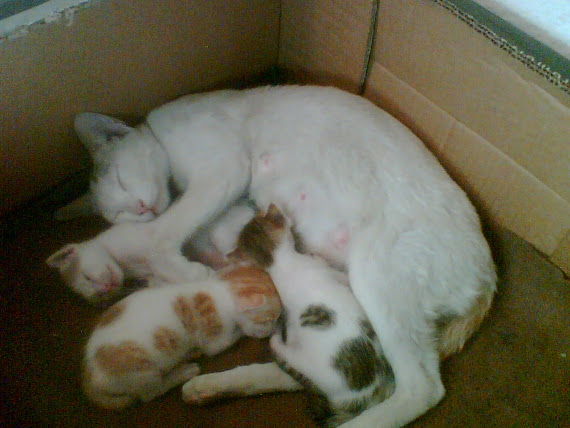
Minnu The Cat & Her Kittens Brownie, Goldie & Blackie
Someone with Nature

Syed Akbar in an island in river Godavari with Papikonda hills in the background
Recognition by World Vegetable Centre

Under the shade of Baobab tree

At Agha Khan Akademi in Kenya
Gateway to the Southern Hemisphere

Convention on Biodiversity

Syed Akbar at the 11th Conference of Parties to the United Nations Convention on Biological Diversity