By Syed Akbar
Hyderabad: After beginning the process for mining uranium in the Nagarjunasagar belt, the city-based Atomic Minerals Directorate for Exploration and Research will search for uranium and thorium reserves in the Kadapa basin including its Kurnool sub-basin.
The Kadapa basin covers a major portion of Rayalaseema area, south of the river Krishna from Srisailam and extends beyond Pennar river. The exploration covers the basin along the Kurnool-Kadapa canal and parts of Kurnool and Kadapa districts including the Rajampet, Vempalle, Mulapalli, Kanampeta and Rachakuntapalle.
The Kadapa basin is rich in mineral wealth, particularly uranium and thorium reserves. The geology of the basin dates back to 2.5 billion years
and contains minerals like diamond (Kohinoor was found here), barite, asbestos, copper, lead, limestone and Kadapa slabs. About 25 per cent of the world’s barite resources are also present in this area.
The present study of uranium and thorium reserves in Kadapa basin gains significance in view of India's plans to generate about 20,000 MWe of nuclear power by 2020. Uranium reserves in the country have been dwindling and the country is now looking forward to thorium. Availability of uranium and thorium reserves in the Kadapa basin will boost the nuclear energy plans of the country with 14 nuclear reactors and nine under construction.
If everything goes on well with the uranium reserves in the Kadapa basin, Andhra Pradesh may emerge as the largest contributor of nuclear energy sources in the country. Mining of uranium has already begun in Nalgonda district.
The study will cover about 11,000 square km area of the 44,000 sq km Kadapa-Kurnool basin in Rayalaseema. To begin with AMD will take up testing of 900 km in a test block of 15 km by 15 km and on its successful completion, the remaining area will be released for survey at an estimated cost of Rs 5 crore. Multiparametre geophysical surveys using gamma and electromagnetic waves are useful in mineral exploration and bedrock mapping studies.
“There is a possibility of encountering a number of surprises in the metallogenic evaluation of the terrain when probed at greater depth than that is usually superficially perceived,” points out RM Sinha, additional director and VP Saxena, regional director, of AMD in their recent study paper.
Though Uranium exploration began in this area in late 1950’s to search for uranium, a proper scientific survey is yet to be taken up. Thorium reserves were found at Gulcheru. Subsequent exploration in late 1980’s also throw some light on signficant uranium reserves in the area.
A decade ago, uranium mineralisation was located in the Kadapa basin near Srisailam, thereby establishing in India for the first time the presence of unconformity related uranium mineralisation — a category considered most potential world over.
Earlier studies by the AMD recognised three distinct types of uranium mineralisation, strata bound, fracture controlled (both basement granite and sediment hosted) and unconformity-related type.
Showing posts with label Atomic Energy. Show all posts
Showing posts with label Atomic Energy. Show all posts
Tuesday, 7 March 2006


Thursday, 13 March 2003
MTAR Technologies develops grid plate for prototype fast breeder reactor
2003
By Syed Akbar
Hyderabad, March 13: India on Sunday crossed another milestone in its nuclear programme with city-based MTAR Technologies developing indigenous technology for "Grid Plate", a crucial component of Prototype Fast Breeder Reactor.
"We have realised this technology for the first time in the world. Our nuclear programme is self-reliant. We are making a transition into domains which others have not made. With the development of the Grid Plate technology India has demonstrated that it can chart on territories which others have not yet ventured into", Atomic Energy Commission chairman Anil Kakodkar said after formally handing over the technology to Indira Gandhi Centre for Atomic Research.
Dr Kakodkar felt that India would eventually usher into inexpensive nuclear electricity regime with a unit of power costing just Rs 2. Dr Baldev Raj, director of IGCAR, said India would soon become a "nuclear guru".
Stating that fast breeder reactors are the only option to meet the increasing demand for power in near future. India is one of the seven countries in the world to build up necessary research and development base for commercialisation of FBR technology.
Prototype fast breeder reactor is a 500 MWe sodium cooled fast breeder reactor. Grid Plate forms an important component of PFB reactor. Grid Plate is a box type structure with bolted construction. The shell assembly is bolted at its periphery to top and bottom plates, which are interconnected by 1758 sleeves. The material of construction is special grade SS 316LN with stringent control on chemical composition and supplementary requirements on mechanical properties and non-destructive examinations. It weighs about 80 tonnes.
"Grid Plate is accorded highest safety classification with stringent manufacturing and inspection requirements. MTAR has specially constructed a large workshop and established the requisite facilities like SPM, large size heat treatment furnace and nuclear clean hall", MTAR chief executive Brig V Sreeramulu said.
It may be recalled that for the fast breeder thermal reactor project, the Grid Plate was the only component that was made in France, in 1976, due to the critical technology involved in its manufacture.
Baldev Raj said the country had been constructing eight nuclear reactors at a cost of Rs 22,000 crore.
The AEC is still working on the proposal to set up a nuclear research and development unit at Visakhapatnam, Anil Kakodkar told reporters later.
By Syed Akbar
Hyderabad, March 13: India on Sunday crossed another milestone in its nuclear programme with city-based MTAR Technologies developing indigenous technology for "Grid Plate", a crucial component of Prototype Fast Breeder Reactor.
"We have realised this technology for the first time in the world. Our nuclear programme is self-reliant. We are making a transition into domains which others have not made. With the development of the Grid Plate technology India has demonstrated that it can chart on territories which others have not yet ventured into", Atomic Energy Commission chairman Anil Kakodkar said after formally handing over the technology to Indira Gandhi Centre for Atomic Research.
Dr Kakodkar felt that India would eventually usher into inexpensive nuclear electricity regime with a unit of power costing just Rs 2. Dr Baldev Raj, director of IGCAR, said India would soon become a "nuclear guru".
Stating that fast breeder reactors are the only option to meet the increasing demand for power in near future. India is one of the seven countries in the world to build up necessary research and development base for commercialisation of FBR technology.
Prototype fast breeder reactor is a 500 MWe sodium cooled fast breeder reactor. Grid Plate forms an important component of PFB reactor. Grid Plate is a box type structure with bolted construction. The shell assembly is bolted at its periphery to top and bottom plates, which are interconnected by 1758 sleeves. The material of construction is special grade SS 316LN with stringent control on chemical composition and supplementary requirements on mechanical properties and non-destructive examinations. It weighs about 80 tonnes.
"Grid Plate is accorded highest safety classification with stringent manufacturing and inspection requirements. MTAR has specially constructed a large workshop and established the requisite facilities like SPM, large size heat treatment furnace and nuclear clean hall", MTAR chief executive Brig V Sreeramulu said.
It may be recalled that for the fast breeder thermal reactor project, the Grid Plate was the only component that was made in France, in 1976, due to the critical technology involved in its manufacture.
Baldev Raj said the country had been constructing eight nuclear reactors at a cost of Rs 22,000 crore.
The AEC is still working on the proposal to set up a nuclear research and development unit at Visakhapatnam, Anil Kakodkar told reporters later.
Subscribe to:
Posts (Atom)
Mother's Care
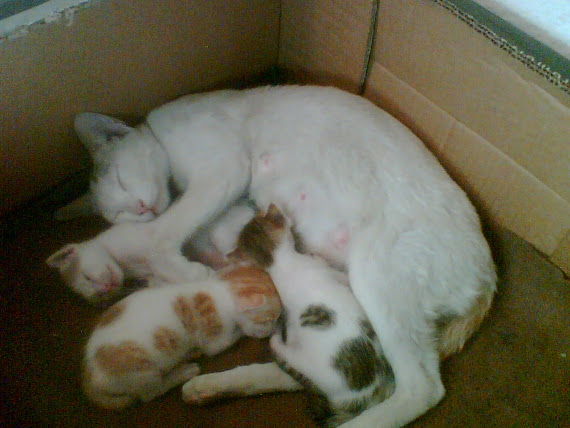
Minnu The Cat & Her Kittens Brownie, Goldie & Blackie
Someone with Nature

Syed Akbar in an island in river Godavari with Papikonda hills in the background
Recognition by World Vegetable Centre

Under the shade of Baobab tree

At Agha Khan Akademi in Kenya
Gateway to the Southern Hemisphere

Convention on Biodiversity

Syed Akbar at the 11th Conference of Parties to the United Nations Convention on Biological Diversity