Showing posts with label Inventions. Show all posts

Monday, 16 August 2010

IIIT-Hyderabad develops machine translation system for Indian languages

2010
By Syed Akbar
Hyderabad, Aug 15: Thanks to Sampark, a machine translation system developed by the city-based International Institute of Information Technology, translating Indian languages is now just a mouse click away.
To be made available to the public in September, the machine translation system is devised to translate Indian languages online.
When fully operational, the system can translate English scripts to as many as 18 Indian languages and vice-versa.
Initially, however, the new software will support only six languages. Later, 12 more will be added to the system in the second phase.
According to Professor Rajiv Sangal, director IIIT-Hyderabad, Sampark, developed by a consortium of 11 institutions led by IIIT, offers translation of Indian languages unlike Google which focuses mainly on English.

Sampark makes translation from one Indian language to another easy

Syed Akbar
Hyderabad, Aug 15: Translation from one Indian language to another is now just a click-of-mouse away, thanks to a machine translation system, Sampark, developed by the city-based International Institute of Information Technology.

The machine translation system is devised to translate Indian languages online. The system will be available for public use in September.

Using Sampark tools one can translate scripts in as many as 18 Indian languages from English and vice versa. Initially, the system will support only six languages and the second phase will include another 12 languages.

According to Prof Rajiv Sangal, director IIIT-Hyderabad, Sampark developed by a consortium of 11 institutions led by IIIT offers translation of Indian languages unlike Google which focuses mainly on English.

MT tools are upcoming areas of study in the field of computational linguistics. Machine translation is the application of computers to the translation of texts from one natural language into another, he said.

One needs to just copy the text one wants to translate and paste in the box provided in the Sampark system. It can also translate entire web page with pictures and graphics intact.

The content available over the web, largely in English will be automatically translated to the Indian languages. This work involves machine translation from English to Indian languages.

Providing affordable and effective education for a large number of students, in geographically distributed locations is being attempted. This has emerged as a new necessity in the networked environment. Work is done on the effective use of information technology tools for this. IT tools can also be effectively used to make primary education available in rural Indian communities in their own languages.

Friday, 8 June 2007

Virtual pooja system: Ring temple bell from home, office

2007
By Syed Akbar
Hyderabad, June 8: An IT professional from Visakhapatnam has developed a software that enables the devout to offer prayers and ring the temple bell in real time while sitting at home.
Unlike the existing "virtual reality" softwares where pooja is offered virtually on-line, the present software, "e-Smarami", functions in real time and the prayers offered are real. The software enables the devout to ring the temple bell, hear the chanting of the priests and see the presiding deity of the temple of their choice.
The programme is so real that the prayers of the person using it are heard in the temple in a low voice as if the person is praying to the deity standing there. Even the conversations on the temple premises are heard live through the software.
"We have installed the software and the related equipment at a few temples on experimental basis in Visakhapatnam. Soon we are going to install it at the famous Dwaraka Tirumala shrine in West Godavari. We are going to hold talks with the Tirumala Tirupati Devasthanam soon," the IT professional, Susharla Narasimha Murthy, told this correspondent.
All that the devout has to do is to make a call to a cell phone number (presently 94907 37373), follow the IVRS announcement and press No. 2. The cell phone call then goes to an equipment called "Sriswaroopa" which is nothing but a simple motor connected to a computer. Once the caller gets through, the motor gets activated and starts rotating. The motor is linked to a specially set up bell in the temple. The bell rings for at least three times and the interregnum the devotee can make his or her wish, which is heard in a low murmur at the sanctum sanctorum. A small speaker is attached to the bell to enable the voice of the devotee to be heard in the temple.
Murthy said "e-Smarami" would soon be available for internet users who will get an additional facility of watching the goings-on in the temple live. A video camera is fitted in the temple. The camera, speaker and the bell work in synchronisation.
To ensure that the programme does not fall into the hands of mischievous or terrorist elements, the software has several inherent security features. The cell phone call is diverted to another cell phone which in turn is diverted to a landline number attached to the computer at the temple.
"Since there are three diversions in a telephone call, the question of security breach does not arise. Every caller will get one minute time to ring the bell and offer prayers. We have devised the software in such a way that the system receives two callers every minute. While one person goes through the IVRS process, the second one offers the prayers," he said.

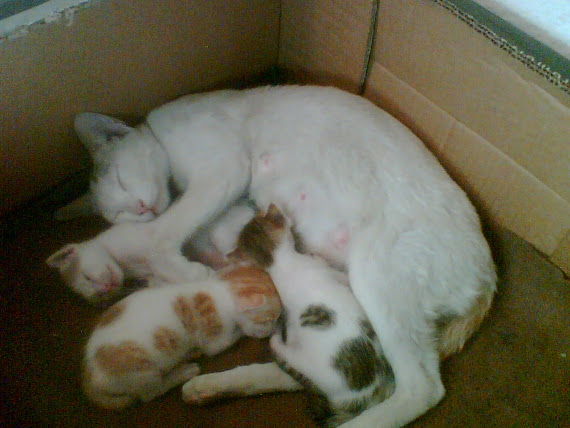
Mother's Care

Mother's Care
Minnu The Cat & Her Kittens Brownie, Goldie & Blackie

Someone with Nature

Someone with Nature
Syed Akbar in an island in river Godavari with Papikonda hills in the background

Recognition by World Vegetable Centre

Recognition by World Vegetable Centre

Under the shade of Baobab tree

Under the shade of Baobab tree
At Agha Khan Akademi in Kenya

Gateway to the Southern Hemisphere

Gateway to the Southern Hemisphere

Convention on Biodiversity

Convention on Biodiversity
Syed Akbar at the 11th Conference of Parties to the United Nations Convention on Biological Diversity