By Syed Akbar
Hyderabad, July 21: Even as the Royal Bank of Scotland sits over a
huge fortune of the Nizam pending tripartite settlement between India,
Pakistan and the Nizam’s heirs, three stout iron safes, lying in
government treasury in Hyderabad, continue to raise curiosity of
historians and old timers.
The three iron safes built in England reportedly contain the personal
belongings of the Paigah nobles, who were second only in royalty and
rank to the Nizam of Hyderabad. They have been under the safe custody
of the State treasury following a court decree pronounced back in 1958.
Two of these iron safes are at the State treasury office at Khilwat
near Charminar. They contain the jewellery and other valuables of
Paigah noble Kurshid Jah Bahadur. The third, at the court of wards at
Nampally, has all the valuable belongings of his brother, Sir
Vicar-ul-Umra, who built the famed Falaknuma Palace. The exact quantum
of and the intrinsic or the antique value of the jewellery, precious
gems and personal belongings is not known.
These safes will be opened and the property inside them will be
distributed among the legal heirs of the Paigah nobles, only after the
court pronounces its final verdict. Half a century has already passed
since the dispute went to court and some of the claimants have passed
away in the meantime. Two separate cases – one related to Kurshid
Jah’s property and the other of Sir Vicar-ul-Umra – are pending before
the AP High Court.
Meanwhile, curiosity writ large on the faces of hundreds of people on
Saturday as officials of different departments under police escort
shifted the two thick iron safes from
the treasury office at Khilwat to Nampally treasury office. The safes
have been lying at the Khilwat office for the last 54 years.
The State government plans to construct a multi-level parking lot
after demolishing the old building built during the times of Nizam VI,
Mir Mahboob Ali Khan. To facilitate the demolition the safes were
shifted after a thorough check of the court seal.
Referring to the two safes now being shifted, MA Bari, who has been
appointed advocate-commissioner by court, told this correspondent that
the property belonged to the Paigahs. “After the abolition of the
Jagir, the valuables were put in the iron safes and deposited in safe
custody following court orders. The jewellery is subject to case No.
CS 14 of 1958. They contain pearls, emeralds and other jewellery,”
Bari added. He however felt that “they are not of much value”.
Paigah sources said the iron safe at the court of wards in Nampally
contains a large portion of the personal wealth of Sir Vicar-ul-Umra,
who was the brother-in-law of Mir Mahboob Ali Khan.
“It is a land standing dispute which dates back to early 1940s. It
took momentum after the abolition of Jagir system in 1956. I feel the
two safes at Khilwat are only of scrap value. But we will know the
truth only after they are opened,” said city historian Dr Muhammad
Safiullah.
He said the State government should have repaired the old building of
Khazana-e-Aamira (State treasury) and conserved it for posterity
instead of pulling it down to make way for a parking lot.
Showing posts with label History. Show all posts
Showing posts with label History. Show all posts
Saturday, 21 July 2012
The tale of three iron boxes: Even as the Royal Bank of Scotland sits over a huge fortune of the Nizam pending tripartite settlement between India, Pakistan and the Nizam’s heirs, three stout iron safes, lying in government treasury in Hyderabad, continue to raise curiosity of historians and old timers.


Wednesday, 18 July 2012
Contrary to popular belief, Hyderabad under the Nizam rule witnessed a powerful nationalist movement with several local leaders launching a fight against the British colonial rule, says senior historian Dr Thirumali
By Syed Akbar
Hyderabad, July 17: Contrary to popular belief, Hyderabad under the
Nizam rule witnessed a powerful nationalist movement with several
local leaders launching a fight against the British colonial rule,
says senior historian Dr Thirumali.
Dr Thirumali, who is associated with the department of history, Delhi
University, said Hyderabad had nationalist aristocracy and several
members of the aristocratic families in the erstwhile Nizam dominion
had participated in the meetings of the Indian National Congress. Dr
Thirumali was delivering Dr Sheela Raj memorial lecture on Mir Mehboob
Ali Khan, Nizam VI, and his times, organised by the HEH the Nizam’s
Jubilee Pavilion Trust here on Tuesday.
Dispelling the wrong notions in people’s minds, he said leaders like
Aghoranath Chattopadhyaya and Mulla Abdul Qayyum were first members of
the Indian National Congress in Hyderabad. “The aristocracy in
Hyderabad was nationalistic aristocracy and not sectarian one. The
voice of Hyderabad was the typical nationalist voice of India,” Dr
Thirumali pointed out.
Referring to the Nizam VII, Mir Osman Ali Khan, he said the Nizam was
a responsible ruler and did not side with Pakistan when the British
had put the option before him. Dr Thirumali quoted the Nizam as saying
“I have nothing to do with Pakistan. I am a Deccani ruler. If I join
Pakistan, I would be a Muslim ruler.” He said the Nizam had wanted
peace in the region. “Had the Nizam joined Pakistan, Hyderabad would
have witnessed the violent incidents that rocked Punjab and Bengal.
The Nizam played a crucial role as the Raj Pramukh in the transition
of Hyderabad from aristocracy to democracy. “Had the Nizam not helped
the Indian government in the peaceful transition of power in
Hyderabad, things would have been quite different,” he said.
Dividing the rule of the Asaf Jahi regime into three stages, he said
the regime of the Nizam VI witnessed development while that of Nizam
VII had the emergence of political parties and politics. He said
Hyderabad had provided raw material in the form of cotton to boost
industrial revolution in England. The Nizams had introduced the land
patta system, the rule of law and three-tier system of governance. The
credit of introducing an Indian language in administration during the
British rule goes to the Nizam VI, Dr Thirumali added.
Senior journalist Dr Rahimuddin Kemal, Sahibzadi Rasheedunnisa Begum,
granddaughter of the Nizam VII, Dr D Bhaskar Rao, curator of the Nizam
Museum, and Mrs Rafaq Hussain of HEH the Nizam’s Jubilee Pavilion
Trust, participated in the meeting.
Hyderabad, July 17: Contrary to popular belief, Hyderabad under the
Nizam rule witnessed a powerful nationalist movement with several
local leaders launching a fight against the British colonial rule,
says senior historian Dr Thirumali.
Dr Thirumali, who is associated with the department of history, Delhi
University, said Hyderabad had nationalist aristocracy and several
members of the aristocratic families in the erstwhile Nizam dominion
had participated in the meetings of the Indian National Congress. Dr
Thirumali was delivering Dr Sheela Raj memorial lecture on Mir Mehboob
Ali Khan, Nizam VI, and his times, organised by the HEH the Nizam’s
Jubilee Pavilion Trust here on Tuesday.
Dispelling the wrong notions in people’s minds, he said leaders like
Aghoranath Chattopadhyaya and Mulla Abdul Qayyum were first members of
the Indian National Congress in Hyderabad. “The aristocracy in
Hyderabad was nationalistic aristocracy and not sectarian one. The
voice of Hyderabad was the typical nationalist voice of India,” Dr
Thirumali pointed out.
Referring to the Nizam VII, Mir Osman Ali Khan, he said the Nizam was
a responsible ruler and did not side with Pakistan when the British
had put the option before him. Dr Thirumali quoted the Nizam as saying
“I have nothing to do with Pakistan. I am a Deccani ruler. If I join
Pakistan, I would be a Muslim ruler.” He said the Nizam had wanted
peace in the region. “Had the Nizam joined Pakistan, Hyderabad would
have witnessed the violent incidents that rocked Punjab and Bengal.
The Nizam played a crucial role as the Raj Pramukh in the transition
of Hyderabad from aristocracy to democracy. “Had the Nizam not helped
the Indian government in the peaceful transition of power in
Hyderabad, things would have been quite different,” he said.
Dividing the rule of the Asaf Jahi regime into three stages, he said
the regime of the Nizam VI witnessed development while that of Nizam
VII had the emergence of political parties and politics. He said
Hyderabad had provided raw material in the form of cotton to boost
industrial revolution in England. The Nizams had introduced the land
patta system, the rule of law and three-tier system of governance. The
credit of introducing an Indian language in administration during the
British rule goes to the Nizam VI, Dr Thirumali added.
Senior journalist Dr Rahimuddin Kemal, Sahibzadi Rasheedunnisa Begum,
granddaughter of the Nizam VII, Dr D Bhaskar Rao, curator of the Nizam
Museum, and Mrs Rafaq Hussain of HEH the Nizam’s Jubilee Pavilion
Trust, participated in the meeting.
Wednesday, 6 April 2011
Aryan theory debunked: Aryans are not the progenitors of north Indian populations
Syed Akbar
Hyderabad: A group of city scientists in collaboration with international researchers on Thursday debunked the age-old Aryan theory that states that Aryans are the progenitors of north Indian population. It also sets aside the Dravidian theory that north Indian and south Indian people are genetically different.
The present-day north Indian and south Indian populations are a genetic mixture of what could be called the ancestral south Indian population and the ancestral north Indian population. The north Indian ancestral group is closely related to European populations unlike the south Indian ancestral group, which is distinctly unique.
Ancestral south Indian population and ancestral north Indian population had married among each other to give raise to the present Indian population, which is neither Dravidian nor Aryan. "It is a genetic mixture of ASI and ANI and is quite distinct from the original ancestral groups," points out K Thangaraj, senior scientists at the city-based Centre for Cellular and Molecular Biology.
The pioneering research study, conducted jointly by the CCMB, Harvard Medical School, Harvard School of Public Health and the Broad Institute of Harvard and MIT, USA, is being claimed as the one "which will rewrite the Indian anthropological and genetics history".
According to the study, nearly all Indians carry genomic contributions from two distinct ancestral populations. Following this ancient mixture, many groups experienced periods of genetic isolation from each other for thousands of years. It has medical implications for people of Indian descent.
Although the genome sequences of any two unrelated people differ by just 0.1 per cent that tiny slice of genetic material is a rich source of information. It provides clues that can help reconstruct the historical origins of modern populations. The research team analysed more than 5,00,000 genetic markers across the genomes of 132 individuals from 25 diverse groups, representing 13 States, all six language families, traditionally "upper" and "lower" castes, and tribal groups.
Dr Lalji Singh, co-author of the study, said India is not a nation of one population. It is a nation of 4635 populations, 532 tribes and 72 primitive tribes. The original tribal population gave birth to the caste system as it diverted from forest life to agricultural activity. Caste system in India dates back to thousands of years and it is not a creation of the British, as is commonly believed.
The researchers also found that Indian populations were much more highly subdivided than European populations. But whereas European ancestry is mostly carved up by geography, Indian segregation was driven largely by caste. "There are populations that have lived in the same town and same village for thousands of years without exchanging genes," says co-author David Reich of Harvard Medical School.
Tuesday, 18 August 2009
Live cannon balls unearthed in Hyderabad: Explosive belongs to Nizam era
By Syed Akbar
Hyderabad, Aug 17: As many as 1127 live cannon balls, at least 150
years old, have been unearthed from a government school at Bollarum
here on Monday during excavation of soil for construction of a new
building complex.
Some of the iron cannon balls contain seals and weigh as much as 12
kgs each. The cannon balls date to the Nizam era and were probably
manufactured at the gun foundry at Basheerbagh in the city.
According to Dr Channa Reddy, director of archaeology and museums,
of the 1127 cannon balls unearthed so far, 320 weigh 12 kgs each while
807 are small and weigh 1.5 kgs each. They measure between four to
eight cm in diametre. "Probably the area once served as a store room
for the army of the Nizam," he said.
However, local ward member Jai Prakash is of the view that the
Britishers kept these cannon balls as a stock for their Thopkhana.They
were later handed over to Indian Army for disposal. He put their age at
70 to 80 years.
The land is said to be donated by the defence personnel to the State
during 1950.
Hyderabad, Aug 17: As many as 1127 live cannon balls, at least 150
years old, have been unearthed from a government school at Bollarum
here on Monday during excavation of soil for construction of a new
building complex.
Some of the iron cannon balls contain seals and weigh as much as 12
kgs each. The cannon balls date to the Nizam era and were probably
manufactured at the gun foundry at Basheerbagh in the city.
According to Dr Channa Reddy, director of archaeology and museums,
of the 1127 cannon balls unearthed so far, 320 weigh 12 kgs each while
807 are small and weigh 1.5 kgs each. They measure between four to
eight cm in diametre. "Probably the area once served as a store room
for the army of the Nizam," he said.
However, local ward member Jai Prakash is of the view that the
Britishers kept these cannon balls as a stock for their Thopkhana.They
were later handed over to Indian Army for disposal. He put their age at
70 to 80 years.
The land is said to be donated by the defence personnel to the State
during 1950.
Subscribe to:
Posts (Atom)
Mother's Care
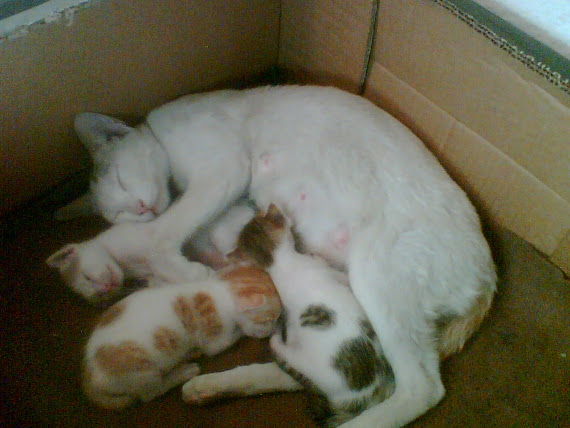
Minnu The Cat & Her Kittens Brownie, Goldie & Blackie
Someone with Nature

Syed Akbar in an island in river Godavari with Papikonda hills in the background
Recognition by World Vegetable Centre

Under the shade of Baobab tree

At Agha Khan Akademi in Kenya
Gateway to the Southern Hemisphere

Convention on Biodiversity

Syed Akbar at the 11th Conference of Parties to the United Nations Convention on Biological Diversity