Showing posts with label Medicare. Show all posts

Wednesday, 20 April 2011

Euthanasia: Country-wise scenario

By Syed Akbar

Countries where euthanasia is legal
----------------------------------------

1. Albania
2. Belgium
3. Luxembourg
4. the Netherlands
5. Mexico

Countries where euthanasia is partially legal
---------------------------------------------------

1. United States of America (States of Oregon and Washington)
2. Australia (northern territory - but repealed now)
3. Switzerland
4. Japan (No specific rules, but euthanasia is practised with restrictions)

Countries where euthanasia is hotly debated
--------------------------------------------------

1. Canada
2. India
3. the United Kingdom

============================

1. India: There have been debates all over country on the need to legalise euthanasia in India. The Central government is yet to take decision on  recommendation by Law Commission to legalise euthanasia for patients, who are terminally ill. Supreme Court says passive euthanasia can be made legal.

2. The United States of America: Mercy-killing is partially legal in that the patient can refuse to take medication to keep his vital functions alive.

3. Canada: Euthanasia is still illegal in Canada and attempts to legalise it in September this year have met with stiff resistance. The debate on the private bill on mercy-killing has been put on hold till February next year.

4. Luxembourg: Euthanasia has been legal in Luxembourg since March 19, 2009 on the condition that terminally ill patients have to seek permission from a panel of experts on health and ethics.

5. Australia: Euthanasia was legal for a brief period in parts of Australia. It was legalised in the northern territory region 15 years ago. Later, the Act was withdrawn.

6. Albania: Albania is the first country to legalise mercy-killing a decade ago, despite protests from religious groups. Five years prior to legalisation, the Albanian government had partially legalised it in 1995, permitting family members to take the decision on euthanasia.

7. Belgium: Mercy-killing has been legal in Belgium since 2002. But the laws are quite strict and those undergoing euthanasia will have to pass through a number of complicated procedures.

8. The Netherlands: Mercy-killing is not a crime in the Netherlands. The country enacted the law in 2002.

9. Switzerland: Euthanasia is partially allowed by Swiss laws i.e. consent of the terminally ill patient is needed.

10. Japan: There are no clear-cut laws on euthanasia in Japan. But mercy-killing is practised in many parts of the country in the absence of specific legislation, either legalising or banning it. Of course, there are a set of guidelines which have to be adhered to before going in for mercy-killing.

11. Mexico: It is partially legal in Mexico in the sense that only passive euthanasia is permitted. In passive euthanasia the terminally ill patient is allowed to die without attending to his medical and health needs.


Friday, 1 April 2011

Birla Institute of Technology and Science Hyderabad campus: Hyderabad joins the international medical race for anti-HIV drug development

2011
Syed Akbar
Hyderabad, March 1: Hyderabad has joined the international medical race for development of drug to cure human immuno-deficiency virus with a team of city researchers taking up the challenge to produce a "non-peptidic small molecule" that prevents the killer virus from replicating in the human body.
The team from the department of pharmacy, Birla Institute of Technology and Science, Hyderabad campus, has already carried out considerable research by contributing to the drug design and "other cutting edge activities" in the creation of this revolutionary anti-HIV drug.
The molecule designed by the BITS team is stable and effectively takes on HIV as well as TB simultaneously, besides boosting up the overall body immunity. The molecule has a template to target HIV protease and TB bacteria enzyme. It will reduce drug dosage and coinfection.
"We are working on non-peptidic small molecule that inhibits the HIV protease enzyme. This prevents the virus from replicating and producing daughter cells. Our molecule targets various stages of HIV life cycle to ensure that the virus is completely killed and the infected person cured. The uniqueness of our molecule is that it acts against both HIV and tuberculosis co-infection," said Prof P Yogeeswari, one of the researchers.
The anti-retroviral therapy now being given to HIV positive people is based on a peptidic molecule, which is unstable. This gives the virus advantage and the person infected has to take anti-retroviral therapy throughout his or her life. Since ART does not target co-infection, the person is subjected to a lot of drugs.
"Since our molecule is non-peptidic in nature, it is stable and inhibits the HIV protease enzyme. If the enzyme is inhibited, the virus stops from replication. Further damage to immune system can be stopped and full immunity is restored over a period of time," said Prof Sriram, the other researcher.
The team is collaborating with the research groups in Brazil and South Africa and is funded by the Department of Science and Technology, India.
The BITS team has made computer designs of both the original virus and its mutants and this makes the task of updating the drug even if the virus mutates further.

Sunday, 19 December 2010

NRIs outsource medicines from motherland: Indian medicines are cheaper but effective

By Syed Akbar
As Ratnakar, a finance manager from Florida, packs his luggage after a month's vacation in Hyderabad to fly back, he makes it sure that he has bought enough stocks of medicines for himself and family. He 
got stocks sufficient for a whole year for just Rs 14,000, which otherwise cost him anything upward of Rs 1,00,000 back home in the USA.

Everyday thousands of NRIs and even foreign nationals purchase large stocks of personal  medicines from India to beat the huge price barrier. According to local pharmacists, NRIs, who visit their dear ones in the city,  make it a point to purchase medicines in the bulk before flying home. They save as much as six to 
10 times on daily use medicines, and two to four times on life-saving drugs. NRIs also obtain medicines from 
their relatives visiting them.

Senior pharmacist P Venkatesh, who runs a leading chain of drug stores in the city, says  "many NRIs and people going abroad for a few months purchase complete stock of medicines from here. Tablets and capsules taken daily for diabetes and heart diseases are usually in demand. They also purchase precautionary drugs 
for fever, pain etc."

According to Ratnakar, since most medical insurance do not cover the cost of medication  post- or pre-
hospitalisation, many NRIs have been preferring to outsource medicines from India. "Whenever I come here I carry lots of medicines for me and my family. I even share some with my friends in the USA," he  says.

US Customs estimates that 10 million US citizens bring in medicines from other countries every year. This is besides two million packages of medicines imported from countries like India. That there's a high 
demand for Indian drugs is evident from the fact that the country exports two-thirds of the medicines it 
manufactures.

"Medicines literally cost a fortune in the USA. It is therefore, not a surprise to see most Indians living in the USA buying medicines from India at a fraction of a cost," says breast cancer specialist Dr P Raghuram. For instance, Anastrazole used to treat hormone receptor positive breast cancer in post menopausal 
women, costs Rs 300 per tablet in the USA compared to just Rs 50 in India. The price difference is six times.

Another drug Herceptin, used for breast cancer patients, who are HER 2 positive, costs Rs 2 lakh per injection in the USA, while it is available at half the price in India.

Moreover, the US rule that prescription medicines should be sold only on prescription by  a qualified medical
practitioner also forces NRIs to outsource medicines from India. "Before going to a pharmacist, a patient in the USA needs to approach a doctor, pay him his fee, which is usually quite high. If the doctor's fee is also included the total cost of prescription medicines will go up to 15 times," says a city pharmacist MN Venkat.

Supporting Venkat's argument, Dr S Vijay Mohan, senior consultant physician, Care Hospital, points out "besides the 10-times more cost factor, drugs aren’t available over the counter so easily abroad. Here, one can purchase most of the drugs without prescription but the same isn’t true for the USA or the UK. In the 
US, except tylenol and panadol, which are US versions of crocin, no other medicine can be procured without 
prescription."

Take the case of  Stieva-A (Renova). It costs about Rs 3,500 for a month's supply in the USA as against Rs 250 in India. The Indian version of cancer medicine Nexavar costs Rs 28,000 a month as against 
its price of Rs 2.80 lakh in the USA. Indian drug Erlocip costs about Rs 1,800 while its US version Tarceva is priced  at Rs 5,500.

While the demand for Indian medicines has been going up, the US does not want to recognise Indian drugs as of high quality. The Centers for Disease Control, a US government body, cautions American  citizens visiting India that they should purchase antimalarial drugs before travel.

"Drugs purchased overseas may not be manufactured according to the United States standards and may not be effective. They also may be dangerous, contain counterfeit medications or contaminants, or be combinations of drugs that are not safe to use," the CDC travel advisory says.

Many doctors point out that medical tourism is booming in India because even the cost of  surgeries is far less here. For instance, heart bypass surgery in the USA will cost around Rs 23 lakh. The same will 
cost between Rs 1 and Rs 2.5 lakh even in high profile corporate hospitals in India.

=====================
Comparative cost of medicines
-------------------------------

1. Furazolidone-Loperamide (Anti-bacterial, for treatment of diarrhoea and enteritis): Rs 25 per 10 tablets (Rs 300 in the USA)

2. Paracetamol-Aceclofenac (Analgesic, anti-pyretic, for treatment of pains and fever): Rs 15 to 30 per 10 tablets depending on the brand (Rs 250 in the USA)

3. Amlodipine (anti-hypertensive, for treatment of angina): Rs 6.50 to Rs 77 per 10 tablets depending on the brand (Rs 500 in the USA)

4. Ampicillin (anti-biotic, anti-bacterial): Rs 55 to Rs 85 per pack of 10 tablets depending on the brand (Rs 700 in the USA)

5. Omeprazol-Domperidone (gastro-oesophagus reflex disease, peptic ulcers disease): Rs 55  per pack of 10 tablets (Rs 450 in the USA)

6. Pantoprazole (ulcers in oesophagus): Rs 63 (Rs 500 in the USA)


7. Metronidozole-Clotrimazole (anti-biotic, amoebicide, anti-protozoal): Rs 47 (Rs 550 in the USA)

8. Sitagliptin (anti-hyperglycemic, brand name Januvia for type 2 diabetics): Rs 500 (Rs 4700 in the USA)

9. Pimecrolimus (for treatment of eczema and atopic dermatitis; trade name elidel): Rs 600 (Rs 9400 in the USA)


Sunday, 18 July 2010

Singareni Collieries - Iron rod pierces through the stomach: It was a miraculous escape for Rajendra Prasad

2010
By Syed Akbar
It was nothing short of a rebirth for assistant foreman P Rajendra Prasad when doctors at  Singareni area hospital in Godavarikhani surgically removed a six-foot thick iron rod  that had pierced through his abdomen.
Like on any other day, Rajendra Prasad on June 28 got into a trolley with 60 other  Singareni workers to go to 10A underground coal mine for duty. But fate had willed  otherwise and the trolley fell with a thud 350 metres down after the ropes supporting it  snapped. Two workers died on the spot and an iron rod pierced through the abdomen of Rajendra Prasad.
Doctors credit Rajendra Prasad for the success of the surgery. The victim was fully awake  and aware and even told the doctors that his blood group was A positive. Rarely do doctors come across such people with a strong will power. “It was his will power that saved him,” admits Dr B Srinivas, one of the surgeons attending him.
“For a moment I thought I would die. But I mustered enough courage and did not give in  till I reached the hospital, 20 km away. My co-workers kept on reassuring me to ensure that I do not slip into shock. I felt fainted for a few seconds as soon I entered the ambulance but the support I got from my friends and doctors save me from what would have been an imminent death,” says Rajendra Prasad, who is now recuperating after a four-hour surgical procedure.
Doctors at Singareni hospital had never come across such an accident victim.  It was really a challenging task for Dr Srinivas and his colleague Dr V Srikanth. The operation was a tough one, but luckily the victim did not have common health problems like diabetes and hypertension.
According to Dr Srikanth, 30 cms of the rod was inside the body. There was no damage to important body organs as the rod had slipped through the abdomen, a few cm away from the liver, spleen and intestines.
“The surgery was no miracle, but the way the rod had pierced through his body leaving vital visceral organs untouched is indeed a miracle. Had these organs been injured, there would have been lot of bleeding and the surgical procedure would have been quite complicated,” observed Dr Srikanth.
About a decade ago, an iron rod pierced through the head of a Singareni worker and doctors at the Nizam’s Institute of Medical Sciences, Hyderabad, successfully removed it. Luckily, the victim had survived.
Doctors do have a difficult task when accident victims, with iron roads or sharp wooden logs pierced through their bodies, are brought to them for surgery. The foreign body cannot be removed with a force. The area around the rod or log is cut to remove it. Then the body is cleaned of rust and other particles to prevent infection.
In the case of Rajendra Prasad, four inches of the body around the rod was surgically cut. “Since it was an iron rod, there’s danger of rust and consequent infection. We cleaned the body and then sutured it,” says Sri Srinivas.

---------==========--------
Some Recent Incidents
---------==========--------

March, 2010:  Doctors at the All India Institute of Medical Sciences, New Delhi, removed
an iron rod from the leg of an auto rickshaw driver in what is termed a rare surgical
procedure. The rod pierced through the ankle of 30-year-old Amrik after his auto hit with
a lorry carrying iron roads.

************

February, 2010:  A 12-year-old boy from Malegaon survived luckily after a 95 cm rod went
through his body, from near the anus to the shoulder, damaging vital visceral organs
including liver.

The mishap occurred while Karim Ali was playing at a construction site near his house.

*************

March, 2009:  Mehul Kumar, 6, was rushed to a hospital in Ranchi after a six feet rod
speared his body. Doctors removed the rod after four hours of surgery. Luckily the body
had no major internal injuries. He fell down from the terrace of his house.
************

December, 2008: Doctors at a hospital in Pune successfully operated on Santosh Kumar, 21,
a construction worker, after six feet rod pierced through his shoulder. He fell down from
the 10th floor of an under-construction building. Doctors described it as a miracle.


Monday, 23 June 2003

Last minute bidding for diagnostic facilities

2003
By Syed Akbar
Hyderabad, June 23: After ailines, it's the turn of the medical sector in the State to offer online and last minute bidding for diagnostic tests and surgery. Come July 1 and as many as 50 common surgeries will be sold for just Re 1.
Doctor Munnabhai Technologies, which recently launched bidding for diagnostic tests, has now opened common surgeries for as low as Re 1 at corporate hospitals. "Surgery at Re 1" offer includes surgeon's fee, anaesthetist's fee, nursing charges, operation theatre charges and general ward accommodation for specified number of days.
All that the patient has to do is to pay the cost of medicines and disposables. Patients are free to purchase these items from the hospital or bring them from outside on their own. The scheme is valid up to August 30. And from September 1, surgeries will be sold through bidding on internet, mobile phone sms or in person.
Doctors, however, are sceptical of the scheme and doubt the quality of the service provided to patients. "Bidding for airlines is OK. It is unethical to bid on one's health. Unless surgeons and hospitals offer heavy discounts or take up charity, it's not possible to offer surgery at Re 1", argues eminent plastic surgeon Dr N Hemant Kumar.
General surgeon Dr B Ramesh Rao welcomes the idea of highly subsidised charges for common surgeries but doubts the viability of the project since the fee hospitals pay to surgeons and anaesthetists is fairly good. He also does not agree with the concept of opening the health sector for open auction. Dr Ramesh feels that there may be some hidden charges as otherwise it may not be possible for hospitals to conduct surgeries at such an unbelievable price.
"This is a special offer where almost 50 kinds of surgeries are sold everyday without any frills, one of each kind, on a first come first served basis to non-emergency patients", says Dr Shantan Reddy, director of Doctor Munnabhai 24x7. Patients can rest assured as the surgeon being nominated will be an experienced one. The charges for the surgeon are included in the Re 1 package as the surgeon is employed by the hospital.
Noted surgeon Dr Viswas Naik does not agree with Dr Shantan Reddy. Says he, "Bidding for diagnostic tests is welcome since machines are involved. You can put hundreds of patients under machines for tests. But in case of surgeries, human life is involved. It is unethical to introduce bidding for surgeries".
"We provide services during off-peak hours/period and utilise the perishable services to generate additional revenues. Like airlines, hospitals too have perishable services like equipment time, hospital rooms, doctors' time and operation theatre time. If not used by the end of the day, they are wasted", clarifies Dr Shantan Reddy.

Friday, 16 May 2003

Munna Bhai system for hospitals

2003
By Syed Akbar
Hyderabad, May 16: Gone are the days when you enter a corporate hospital or a diagnostic centre and silently pay whatever bill is thrust into your hands. Now you can quote your own price through a telephone bidding for any of the diagnostic tests on offer.
Enter the world of open auction in health. Like in airlines, you can participate in the health bidding, quoting as little as Rs 1500 for an MRI scan costing Rs 6,500 or Rs 500 for a plan CT scan which otherwise is available for Rs 2,500. Ordinary lab tests can be had for a mere Rs 25 per test.
But the only hitch is that you have to wait for three days to a week to get the tests done or you may have to visit the hospital at an untimely hour. In some cases, you may simply get the report sans the film, which is quite costly. Those requiring urgent medical tests have no option but to pay the price fixed by the hospital or the diagnostic centre. You may also not get the hospital of your choice.
A group of corporate hospitals and diagnostic centres in Hyderabad has now come out with a novel concept of utilising non-peak hours by offering medical tests at highly discounted prices through open auction. The savings range between 25 and 75 per cent depending on one's requirement, choice of healthcare provider and urgency.
Introduced for the first time in the country by Hyderabad-based Doctor Munnabhai Technologies P Limited, the concept of medical bidding is fast catching up with patients. Inspired by Sanjay Dutt-starrer Munnabhai MBBS, the company has enrolled a group of hospitals and diagnostic centres for the novel offer, "Doctor Munnabhai 24x7".
"There's no compromise on the quality. The reports are accurate since the tests are conducted on the same machines. We are able to offer tests at discounted prices by utilising non-peak hospital hours, say 6 am to 9 am and 8 pm to 12 midnight. Even at the discounted rate of Rs 1500, some hospitals make a profit of Rs 300, if the number of films is restricted. We at Image have been offering MRI scan for Rs 2,950 for the past one year. We give utmost priority to quality and accuracy as our reports are open to disputes in consumer fora", says eminent gastroenterologist Dr CL Venkat Rao who is also a director of Image Hospitals.
And how do hospitals make the profit by offering huge discounts? According to Dr Venkat Rao, the prices vary from patient to patient. "Many hospitals do not charge anything for white ration cardholders. For others they charge at normal rates", he clarifies.
It is not that every patient who participates in the bidding gets the tests done at discounted prices. The bids every day. Sometimes a patient may be lucky to get MRI scan done for just Rs 1500 or he may have to pay even Rs 5000 for the same test.
"Our concept works on the lines of airlines operators. Like airlines have introduced bidding for their vacant seats, we are offering discounts for tests at non-peak hours. We have been receiving about 100 calls a day since the concept was introduced on May 7 and 50 per cent of the callers have availed of discount benefits. Patients need not worry about the quality as the hospitals and diagnostic centres covered in our promotional campaign are of top standard", points out Mohan Kaushik, vice-president (marketing) of the company.
The company has opened a website offering a plethora of medical and health services both for patients and doctors. All they have to do is to participate in the bidding at the stipulated hour and quote their own price tag.
There are five offers on the website for patients to choose form. In the "Instabuy" offer, a patient can save up to 25 per cent on diagnostic tests if he or she required it immediately. One can save up to 50 per cent in the "Bidbuy" offer but will have to wait for a maximum of three days.
Patients may join Munnabhai Club and participate in auction for various tests. The auction starts at Re.1. Munnabhai will choose the healthcare provider but appointment may take a week.
Dr Venkat Rao, however, feels that hospitals may not sustain the heavy discounts for a long time. It is just a promotional offer. The prices may change at a latter date.
Senior radiologist Dr B Murali says it is possible to conduct tests at discounted prices if the number of films in MRI scan is brought down. "We take a series of films for MRI scan. Each film costs about Rs 300. If we take 10 films, the cost goes up to Rs 3000. The report is given to the patient without or with a limited number of films", he clarifies.
Though Apollo Hospitals is included in the Munnabhai list, it has backed out of the discounts offer.

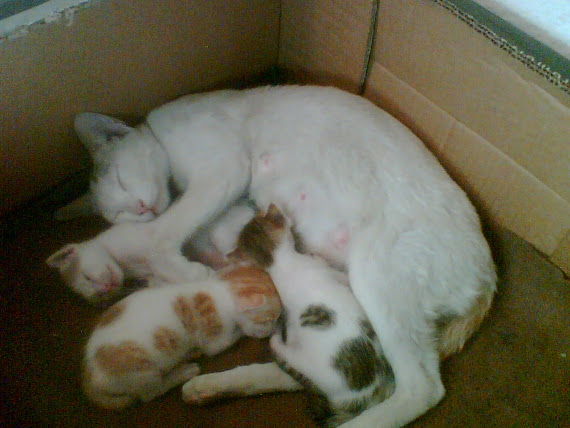
Mother's Care

Mother's Care
Minnu The Cat & Her Kittens Brownie, Goldie & Blackie

Someone with Nature

Someone with Nature
Syed Akbar in an island in river Godavari with Papikonda hills in the background

Recognition by World Vegetable Centre

Recognition by World Vegetable Centre

Under the shade of Baobab tree

Under the shade of Baobab tree
At Agha Khan Akademi in Kenya

Gateway to the Southern Hemisphere

Gateway to the Southern Hemisphere

Convention on Biodiversity

Convention on Biodiversity
Syed Akbar at the 11th Conference of Parties to the United Nations Convention on Biological Diversity