Showing posts with label Radiation. Show all posts

Friday, 25 March 2011

Japan nuclear mishap: No radioactivity found in Indian cities including Hyderabad

2011
Syed Akbar
Hyderabad, March 25: Hyderabadis need not worry about the radioactivity levels in the city's air, water and fresh vegetables. The radioactive contamination levels in the city are about 1000 times less than the maximum permissible limits fixed by the Department of Atomic Energy.

The DAE has been conducting sample studies on almost daily basis on environmental safety levels of iodine-131 and caesium-137, both radioactive isotopes, in Hyderabad and other places following the nuclear mishap in Japan.

The ESL studies have been conducted in Tarapur, Kalpakkam, Kakrapar, Kaiga, Kudankulam, Jaduguda, Chhattrapur, Alwaye and Mumbai, besides Hyderabad. The Nuclear Fuel Complex in the city processes uranium ore and makes it into nuclear fuel for the nuclear power plants in the country. There have been fears that the location of NFC in the heart of the city poses danger to the safety of the people.

The uranium handled at NFC is not radioactive and its radioactivity increases once the fission reaction is triggered in a nuclear reactor. Since NFC does not handle heavy water, the issue of radiation leakage due to fission reaction does not arise, according to a senior NFC official.

The DAE teams analysed water, air and fresh vegetable samples at random to check the presence or otherwise of iodine-131 and caesium-137. Both the radio-isotopes of iodine and caesium are released into atmosphere during nuclear fission. The virtual absence of these radio-isotopes reveals that the nuclear mishap in Japan had no effect on Indian cities, including in places where nuclear plants or mining projects are located.

According to the latest data released by Atomic Energy Regulatory Board on Friday, there's no radio iodine in the atmosphere of Hyderabad. "No detectable activity was observed in any of the locations. The levels are 1000 times lower than the regulatory limits for restriction on consumption of food items and restriction to move out in the open air," the AERB update said.

Presence of radioactivity is measured in Becquerel or Bq.
Radio-isotope of caesium 137 was present in 0.002 Bq.m2), which is about 1000 times less than the maximum permissible levels. In case of water, radio iodine and caesium 137 were present in   0.1 Bq.l-1).

When fresh vegetables were analysed in Hyderabad, both radio iodine and caesium 137 were present in 0.3 Bq.kg-1. Similar results were obtained from other places in the country, confirming that the nuclear mishap in Japan had thus far no impact on India.

Friday, 15 May 2009

UV Index very high: Hyderabad fast turning into a "radiation city"

Syed Akbar
Hyderabad: Hyderabad is fast turning into a "radiation city" with harmful ultraviolet (UV) rays hitting the city at "extreme" levels.
UV forecasts for Hyderabad show that the radiation falling down on the city from the sun for most part of the year is on the higher side, which is an indication that all is not well with the ozone layer above and the city's atmosphere.
Hyderabad is bracketed with concrete jungles like Mumbai, Kolkata, Bangalore and Chennai as these cities record "extreme" UV radiation for more than three days a week. However, Delhi appears to be slightly better as the UV radiation levels there are generally "high" to "very high" but rarely "extreme". WHO standards specify that in places where the UV radiation is "extreme", people should better keep indoors and move out only when necessary.
Ultraviolet rays falling on the earth are classified into various categories based on the intensity of the radiation and the harm they cause to human beings and animals. The World Meteorological Organisation, a WHO body, has standardised the UV radiation levels with its "UV Index" which is a simple measure of the UV radiation level at the earth's surface. Hyderabad's UV Index shows a measure of 11, the highest point in the UV scale.
No wonder then that there has been a spurt in skin diseases in Hyderabad may be because of extreme levels of UV radiation. "Most of the cases relate to photo-ageing and skin cancer due to penetration of the rays into the skin. Even if one is in a car the rays can penetrate the glass and impact the skin. The most common skin allergy cases that come to us are related to UV radiation called polymorphic light eruption," senior dermatologist Dr Anup Lahari pointed out.
The values of the UV Index range from zero to 11 and the higher the Index value, the greater the potential for damage to the human body and the less time it takes for harm to occur. On the higher side is the "extreme" and on the lower side is the "very low". In between UV Index is categorised as "low", "medium", "high" and "very high".
The WMO and the World Climate Research Programme as also the India Meteorological Department regularly issue UV forecasts for different cities around the world and in India respectively. The IMD monitors UV levels at its 45 radiation observatories spread across the country.
The UV Index this week is 11 i.e. "extreme" for Hyderabad, Chennai and Mumbai, while it is 8 (very high) for Delhi, 7 (high) for Chandigarh and 10 (very high) for Kolkata. The Index last week was also "extreme" for most part of the week for Hyderabad and other cities except Delhi.
The main reason given for the high intensity of UV radiation in Hyderabad is rapid urbanisation and high levels of pollution.
"As UV radiation can neither be seen nor felt, the UV Index is an important tool to raise awareness of the problem and alert people on a daily basis to take prompt, appropriate and protective action. That Hyderabad has high UV Index is an indication that the ozone layer is not properly filtering the sunlight. If the ozone does its job properly, the harmful radiation are filtered out. The high UV Index shows that the ozone layer has become thin," says Prof OSRU Bhanu Kumar, head of the department of environmental sciences, Andhra University.
Health experts and environmentalists warn that damage from the exposure to the UV rays is cumulative and over a period of time it will lead to serious diseases of the eye, including cataract and macular degeneration.
Consultant radiologist of Care Hospital Dr B Murali suggested that one should go in for massive tree plantation and keep off the sun to the extent possible to avoid UV radiation. "UV radiation exposures are largely preventable. The best protection is achieved by practising a combination of recommended safe behaviours. Limit exposures to sun rays when they are the strongest i.e. between 10 am and 4 pm. Seek shades such as trees or umbrella whenever possible. Use a broad-spectrum sunscreen with sun protection factor of at least 15. Sunglasses can provide 100 per cent protection," he said.
Children are at high risk as on an average they get three times more sun exposure and thus are subject to damaging cumulative effects of UV. It is estimated that 80 per cent of lifetime sun exposure occurs before 18 years of age.
"With the UV rays being equally extreme even in a "garden city" like Bangalore, there has been an increase in eye related problems there. Dr
NM Sudha, senior ophthalmologist from Bangalore, pointed out that ultra violet light is as a causative factor in several eye problems such as cataract, retinal degeneration and surface problems such as pterigyum.

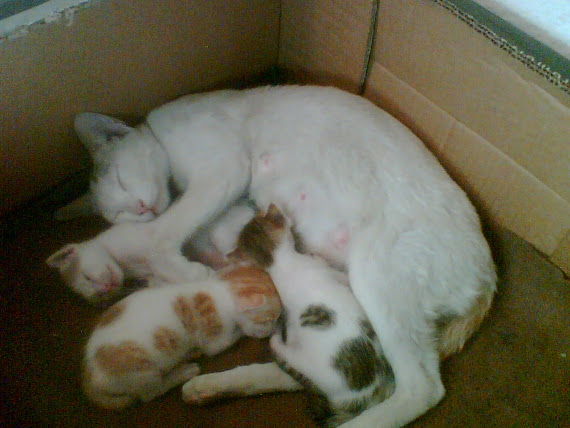
Mother's Care

Mother's Care
Minnu The Cat & Her Kittens Brownie, Goldie & Blackie

Someone with Nature

Someone with Nature
Syed Akbar in an island in river Godavari with Papikonda hills in the background

Recognition by World Vegetable Centre

Recognition by World Vegetable Centre

Under the shade of Baobab tree

Under the shade of Baobab tree
At Agha Khan Akademi in Kenya

Gateway to the Southern Hemisphere

Gateway to the Southern Hemisphere

Convention on Biodiversity

Convention on Biodiversity
Syed Akbar at the 11th Conference of Parties to the United Nations Convention on Biological Diversity